AI in Casting: Scoring Explained

AI is transforming casting by analyzing audition videos and demo reels with precision. Algorithms evaluate facial expressions, vocal tone, body language, and emotional delivery to create actor profiles, speeding up the casting process and offering unbiased, data-driven insights. Nearly 40% of major studio productions now use AI for casting validation. For actors, AI tools present opportunities to refine performances with audition feedback and secure roles faster.
Key AI Evaluation Factors:
- Facial Expressions: Assesses emotional delivery through detailed frame-by-frame analysis.
- Vocal Tone: Analyzes clarity, tone, and alignment with scripts using audio metadata.
- Physical Traits: Matches roles based on attributes like body type and headshots.
- Chemistry Prediction: Simulates group dynamics to predict ensemble compatibility.
- Consistency: Tracks stable performance across takes, rewarding precision.
Platforms like CastmeNow automate submissions, ensuring actors stay competitive by matching profiles to roles 24/7. With AI-driven casting, maintaining polished profiles, high-quality tapes, and relevant keywords is critical to standing out.
Main Factors AI Algorithms Evaluate
AI systems dissect audition videos into measurable data points, analyzing everything from facial expressions to vocal nuances. Knowing what these systems evaluate can help actors fine-tune their self-tapes and demo reels for better algorithmic scoring. Below are the key factors these algorithms consider.
Facial Expressions and Emotional Range
Using computer vision, AI analyzes facial movements frame by frame to evaluate emotional authenticity. It assesses how effectively emotions like empathy, anger, or vulnerability are conveyed through subtle facial cues. For example, the system uses metadata extraction to measure sentiment and ensure the emotional delivery aligns with the scene's demands.
Lighting, image clarity, and face visibility are critical for accurate analysis. Poor lighting or low-resolution videos can hinder the system’s ability to score performances accurately. Interestingly, AI scoring is reported to be three times more consistent than human evaluations because it applies uniform criteria across thousands of auditions. Actors should prioritize high-quality lighting and resolution in their self-tapes to ensure the system captures every detail.
Vocal Tone, Pitch, and Delivery
After facial analysis, AI evaluates vocal performance. Using natural language processing, the system transcribes audio into text and enriches it with metadata about tone, timing, and sentiment. This analysis focuses on vocal modulation, clarity, and how well the delivery aligns with the script. For dialogue-heavy roles or voiceover work, these metrics are especially important.
One advantage of voice-based AI is its objectivity. It evaluates factors like pacing without the influence of human fatigue or bias. To optimize for this, actors should ensure their recordings have clear audio with minimal background noise.
Physical Characteristics and Role Fit
Modern algorithms prioritize how well an actor's physical attributes align with the role's requirements over factors like fame. For example, the system evaluates headshots for clarity and scans for specific traits such as body type or tattoos that match casting needs.
"Casting algorithms in 2026 focus on how closely your profile matches a specific casting search, not how famous or experienced you are." - Maddie Westbrook, allcasting
Profile completeness also plays a role. Including details like union status, skills, and multiple "looks" can improve an actor’s ranking. Additionally, using industry-specific keywords like "commercial actor" or "voiceover" helps algorithms match talent with roles. Essentially, headshots and profiles are treated as data points that influence search visibility.
Chemistry and Group Dynamics Prediction
AI can predict on-screen chemistry between actors - even if they audition separately. By analyzing historical performance data and behavioral patterns, the system simulates virtual reading partners to assess ensemble dynamics.
The algorithms look for complementary signals, such as synchronized timing and energy, to predict how well actors might work together. This data-driven approach allows casting teams to create shortlists based on ensemble compatibility before actors even meet.
Performance Consistency and Adaptability
Consistency is a key metric for AI evaluations. The system tracks whether actors deliver stable emotional cues across multiple takes, which signals reliability. Platforms have also started using "activity signals" like login frequency and response times as indicators of adaptability and availability.
AI can even assess how well actors respond to direction by comparing different takes of the same scene. Consistent performers tend to have a 15% lower early screening rate when evaluated by AI compared to human-only reviews, as algorithms reward technical precision and repeatability.
Technical Components of AI Scoring Models
To grasp how AI scoring models work, it's essential to understand the technical tools that power them. These systems use a mix of computer vision, voice analysis, and machine learning to turn raw video and audio into meaningful performance metrics.
Emotion recognition technology relies on computer vision to analyze facial movements and subtle micro-expressions. This data is processed to measure emotional authenticity. Some platforms even combine various data streams to provide a more comprehensive performance evaluation, sometimes comparing results against iconic benchmarks.
Voice analysis algorithms take audio input and add layers of metadata, such as tone, timing, and sentiment. Natural language processing (NLP) models then dissect speech patterns and assign statistical weights to vocal delivery based on predefined success metrics. For example, a 2025 study by the University of Chicago Booth School of Business and Erasmus University Rotterdam revealed that recruiters using voice-based AI tools managed to process 40% more candidates weekly while shaving 25 minutes off screening time per individual.
Machine learning models play a crucial role by analyzing historical audition data to predict future performance outcomes. Trained on expert-reviewed datasets, these models learn what defines success and can predict audience responses to actor-character pairings with an impressive 92% accuracy. Films cast using AI have shown a 34% increase in audience retention compared to those cast through traditional methods [10, 15].
AI systems also adapt to real-time casting trends to refine their recommendations. By analyzing current industry data, these tools can identify performance styles that resonate with modern audiences. Many platforms now include features like diversity scoring and transparency logs, which explain casting decisions and help reduce stereotyping. Some advanced systems can even generate actor-role matchings in just 2.4 seconds, enabling casting teams to explore multiple configurations quickly [10, 15].
AI Scoring vs. Traditional Casting Methods
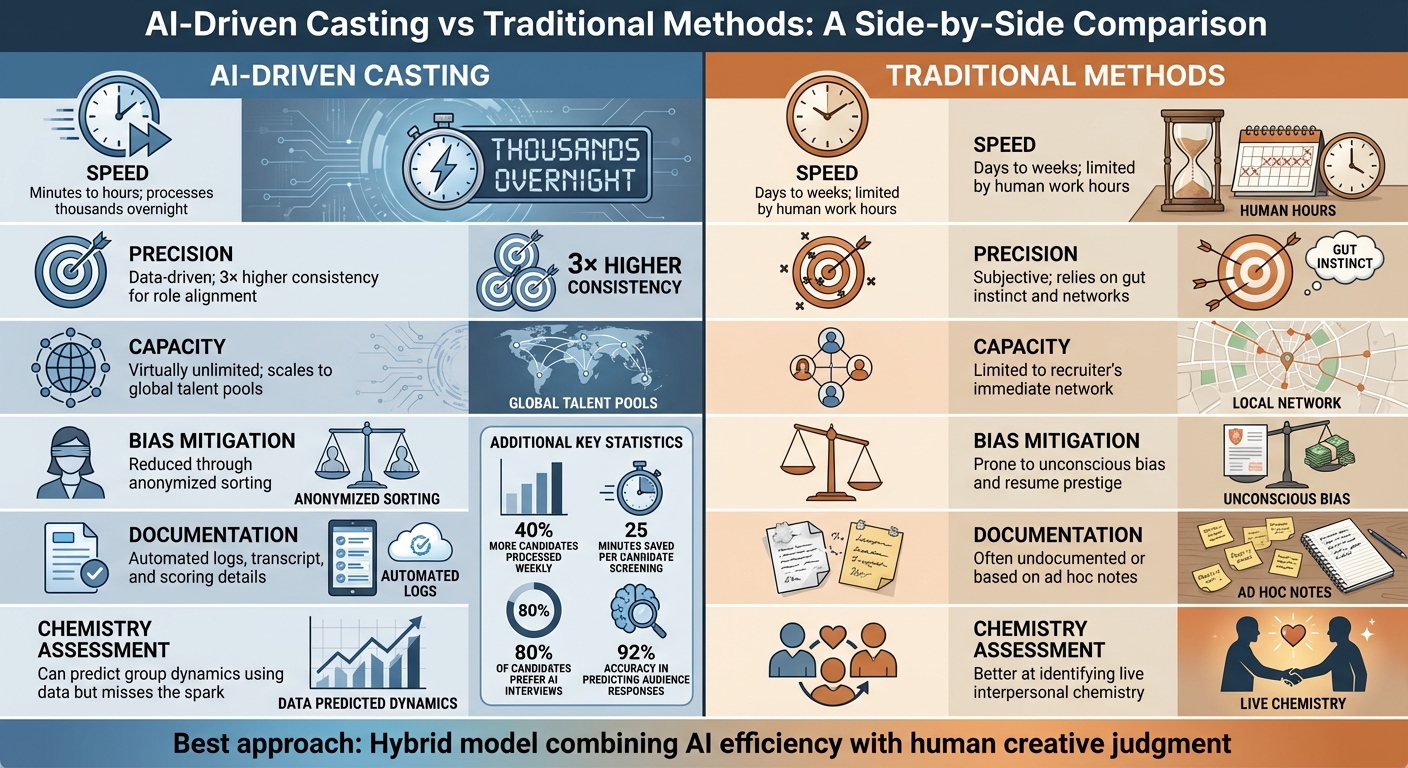
AI-Driven vs Traditional Casting Methods Comparison
AI-driven scoring is changing the casting game by analyzing and ranking thousands of actor profiles in just minutes. This approach replaces the old, time-consuming process of manual reviews, which often takes days or even weeks to complete.
These tools don’t just save time - they redefine efficiency. For instance, voice-based AI systems can handle 40% more candidates every week, reduce screening time by 25 minutes per candidate, and deliver results with three times the consistency of human evaluations. Plus, 80% of candidates prefer AI interviews because they eliminate scheduling headaches.
But speed and efficiency aren’t the only advantages. AI shortlists talent based on measurable, script-specific skills, offering an objective approach to casting. By anonymizing profiles, AI also reduces the biases that often creep in through personal networks or the prestige of a resume. As industry analyst WriteSeen puts it:
"AI casting disrupts slow, network-dependent workflows."
That said, the human touch is still essential. While AI excels at sifting through large volumes of candidates, the final decisions often hinge on chemistry and that elusive “spark” between actors. A hybrid approach works best - AI handles the heavy lifting, and casting directors focus on creative judgment, allowing them to rely on their instincts where it matters most (as noted by Humanly).
Here’s how AI-driven scoring stacks up against traditional casting methods:
Comparison Table: AI Scoring Factors vs. Traditional Methods
| Feature | AI-Driven Scoring | Traditional Casting Methods |
|---|---|---|
| Speed | Minutes to hours; processes thousands overnight | Days to weeks; limited by human work hours |
| Precision | Data-driven; 3× higher consistency for role alignment | Subjective; relies on gut instinct and networks |
| Capacity | Virtually unlimited; scales to global talent pools | Limited to the recruiter’s immediate network |
| Bias Mitigation | Reduced through anonymized sorting | Prone to unconscious bias and resume prestige |
| Documentation | Automated logs, transcripts, and scoring details | Often undocumented or based on ad hoc notes |
| Chemistry Assessment | Can predict group dynamics using data but misses the spark | Better at identifying live interpersonal chemistry |
This comparison highlights how platforms like CastmeNow are making casting faster and more efficient while still leaving room for human creativity and judgment.
How CastmeNow Helps Actors Navigate AI-Driven Casting
With casting directors increasingly using AI scoring to sift through thousands of auditions, actors are facing a new hurdle: standing out and securing opportunities before others do. This shift to automation emphasizes precision and data-driven evaluations. CastmeNow steps in to tackle this challenge by automating submissions, allowing actors to focus on delivering performances that align with AI algorithms.
Automated Role Matching and Submissions
CastmeNow integrates seamlessly with platforms like Casting Networks and Actors Access, leveraging your headshots, reels, credits, and skills to pinpoint roles that suit you best. The platform operates around the clock, monitoring postings and submitting your profile to high-match roles within minutes. For instance, in November 2025, actor Moses Jackson was submitted to 484 roles in just two weeks, leading to 20 auditions and 2 bookings. Similarly, Ja'son Manwill saw 700 automated submissions, resulting in 18 auditions.
"It works WHILE I am on set automatically submitting my profile every 10 minutes to new postings from casting directors and then submitting my headshots and proper video for the role applying for."
– Ja'son Manwill, Actor
The platform's AI doesn’t just submit - it selects the most relevant media for each role and can even add personalized notes to help your application stand out in AI-driven shortlisting processes. This automation ensures you're always in the running for opportunities, without the constant manual effort.
Time-Saving Benefits for Actors
CastmeNow’s efficiency goes beyond role matching - it slashes the time actors spend on submissions. The manual vs automated casting submission process is a common debate, as scrolling through casting sites and uploading materials is notoriously time-consuming. CastmeNow eliminates this grind, allowing actors to focus on their craft. On average, users report 10 times more auditions compared to manual submissions, and the platform has collectively saved actors over 2,150 hours. Ki'mari Lavender, for example, booked a role in New York City within 24 hours of signing up and secured two bookings in her first month.
"Self-submission is a full-time job, and it's challenging when managing other responsibilities... It submits way faster than I can."
– Cesar, Actor
This saved time can be redirected toward perfecting the subtle facial, vocal, and emotional details that AI scoring models prioritize.
Free 30-Day Trial and Accessibility
To make the platform accessible, CastmeNow offers a free 30-day trial with full access to all features - no credit card required. After the trial, actors can choose from two plans: the Basic plan at $12 per month for up to 10 daily submissions or the Plus plan at $28 per month, which includes unlimited submissions and advanced analytics. This trial period gives actors a chance to experience how automated, AI-driven submissions can increase their visibility and open doors to more auditions in a fast-paced industry where timing and relevance are everything.
Key Takeaways
AI scoring in casting leverages advanced analytics to evaluate key aspects of an actor's performance, including facial expressions, vocal delivery, physical traits, and consistency. What used to take days or even weeks now takes just minutes, as these systems provide ranked role matches almost instantly. For actors, this means it's crucial to fine-tune headshots, demo reels, and profile keywords to ensure algorithms can accurately assess and categorize their skills.
This shift to AI-powered casting prioritizes speed and precision. Casting directors can now review far more candidates while cutting down on the time spent screening unqualified applicants. For actors, maintaining up-to-date profiles with polished self-tapes and relevant keywords is essential for staying visible in this competitive landscape. These advancements underline AI's growing influence on the casting process.
Platforms like CastmeNow take automation a step further by submitting actor profiles to sites like Casting Networks for role matching and Actors Access around the clock. This ensures actors are continuously matched to roles that fit their profiles, freeing up time for them to focus on honing their craft. CastmeNow even offers a free 30-day trial - no credit card required - so actors can see firsthand how automated submissions can increase their audition opportunities.
FAQs
How can I improve my AI casting score?
To boost your AI casting score, make sure your profile is 100% complete and always kept up-to-date - this plays a big role in how you're ranked. Stay engaged by logging in frequently, applying thoughtfully to roles, and responding promptly to casting calls. Tools like CastmeNow can simplify the process by automatically matching your profile with relevant roles, saving you time and improving your visibility with casting algorithms.
What self-tape setup helps AI read my performance best?
To get the best results when AI evaluates your performance, it's important to set up your self-tape correctly. Use proper lighting to ensure your face is well-lit, choose a neutral background to avoid distractions, and make sure your audio is clear and free of noise. Additionally, keep your framing consistent so the focus stays on your performance. These steps make it easier for the AI to assess your work without being thrown off by technical problems.
Can AI scoring still be biased?
Yes, AI scoring can still show bias. This can happen because of things like unbalanced training data, poorly designed models, or shortcomings in how the system is evaluated. These issues can result in unfair results or even systematic discrimination. Addressing this requires thorough oversight and constant refinement of the algorithms.