Film Subsidies vs. Tax Credits: Casting Impact

Film subsidies and tax credits are tools states use to attract film and TV productions, but they work differently and have varying effects. Subsidies involve direct cash payments to productions, while tax credits reduce or refund taxes. Both aim to boost local economies and create jobs, especially in casting and crew hiring. However, these programs often result in high taxpayer costs with limited long-term benefits.
Key takeaways:
- Subsidies: Direct payments based on in-state spending (e.g., wages, vendor costs). Examples: Louisiana (25%), Alaska (up to 44%).
- Tax Credits: Reduce tax liability or provide refunds. Examples: Georgia (20%-30%), California (20%-40%).
- Short-term benefits: Increased local hiring, especially for TV productions (up to 55.4% growth in some states).
- Challenges: High costs for taxpayers (e.g., $324,838 per job in Massachusetts) and limited long-term industry growth.
Quick Comparison:
| Feature | Subsidies (Cash Payments) | Tax Credits (Refundable/Transferable) |
|---|---|---|
| Funding Type | Direct cash from state | Tax reduction or refund |
| Monetization | Immediate cash flow | Sold to third parties or refunded |
| Rates | 20%-44% | 25%-40% |
| Examples | Louisiana, Alaska | Georgia, California |
While these programs create immediate opportunities for actors and crew, their long-term effects on local film industries remain uncertain. States face challenges balancing costs with sustainable growth.
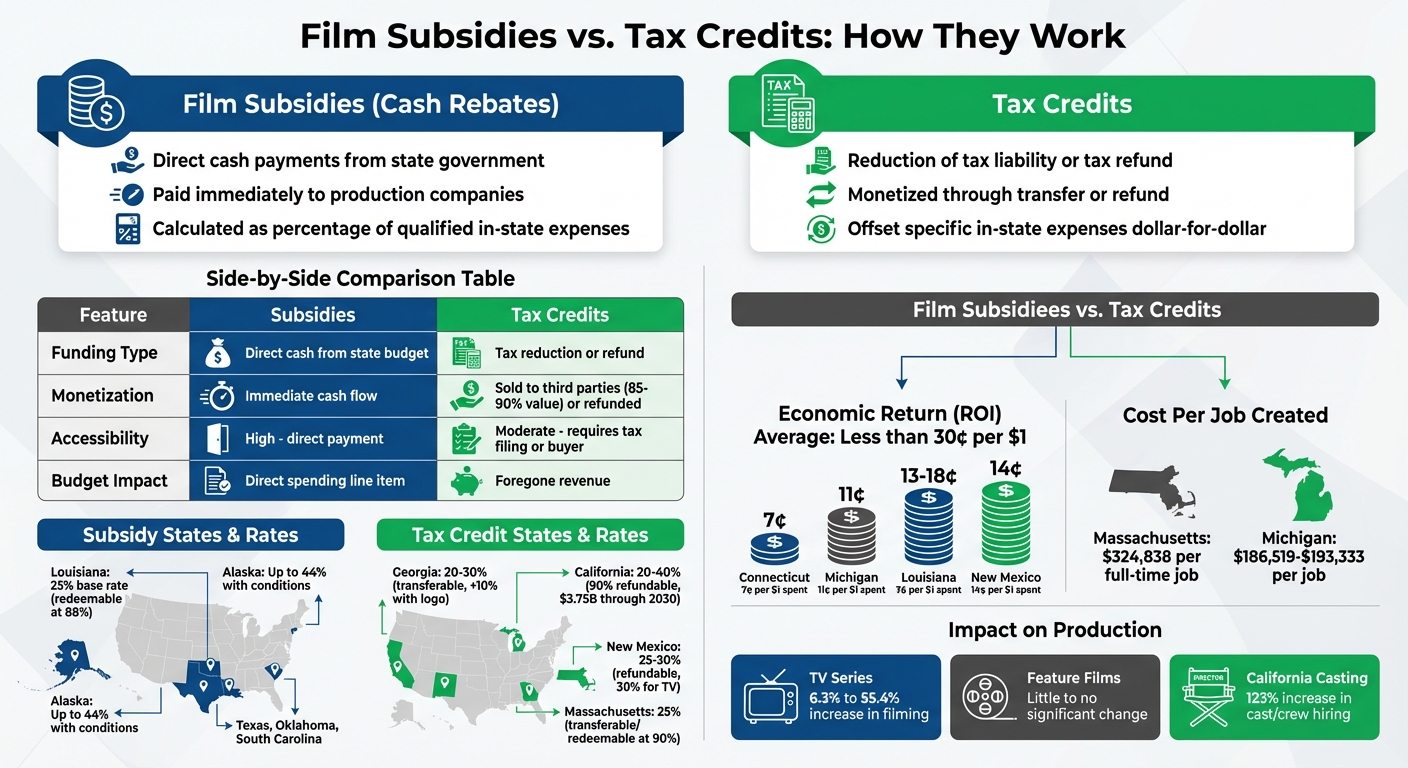
Film Subsidies vs Tax Credits: Complete Comparison Guide
The Two Types of Production Incentives for Your Film
Film Subsidies Explained
Film subsidies are cash payments provided by state governments directly to production companies. Unlike tax breaks that simply lower the amount owed, subsidies deliver funds straight into the hands of filmmakers. As Greg Albrecht, Chief Legislative Economist for Louisiana, put it:
"It's got nothing to do with tax... We're just using the tax-filing process and the Department of Revenue as the paying agent for a spending program".
How Film Subsidies Work
Subsidies are calculated as a percentage of qualified in-state expenses, which typically include:
- Wages for crew and cast
- Payments to local vendors
- Other production costs incurred within the state
The rates vary significantly across states. For example, some start with a base rate of 20% to 30%, while Alaska’s program can go as high as 44% of qualified expenses if productions meet certain conditions, like hiring local residents or filming in remote areas.
To be eligible, productions must hit a minimum spending requirement. In Massachusetts, this threshold is $50,000, while New Mexico sets it at $500,000 for feature films. States also offer additional incentives: Louisiana adds 5% for shoots outside New Orleans, and New Mexico provides an extra 10% for filming more than 60 miles from Santa Fe or Albuquerque.
States That Offer Subsidies
Two major players in the subsidy game are Louisiana and New Mexico. Louisiana offers a 25% base rate on certified expenses, with production companies able to sell their earned credits for cash at 88% of the credit’s value. New Mexico, on the other hand, provides 25% for films and 30% for television productions, issuing refundable credits that turn into direct cash payments after tax filings.
Wisconsin is also rejoining the scene. In July 2025, the state reinstated its film incentive program, effective January 2026, offering a 30% transferable tax credit on qualified in-state spending. This move underscores the ongoing competition among states to attract production dollars. While subsidies provide direct financial support, they operate differently from tax credits, which will be discussed in the next section.
Tax Credits Explained
Tax credits directly reduce a production company's tax bill by offsetting specific in-state expenses dollar-for-dollar. However, most film production companies are set up as single-purpose entities, often with minimal or no state tax liability. For example, a company formed solely to produce one movie typically owes very little in state taxes. To make these credits practical, states have designed ways to "monetize" them, primarily through two methods.
Refundable credits turn any unused credit into a cash refund. States like New Mexico and Ohio use this approach, effectively converting the credit into a direct payment after the production files its tax return. On the other hand, transferable credits - used in states such as Georgia and Pennsylvania - allow production companies to sell their credits to third-party taxpayers, often large corporations with hefty tax bills. These buyers then use the credits to lower their own state taxes. This system doesn't just benefit productions; it also influences local hiring and spending patterns.
Tax credits typically cover a percentage - ranging from 25% to 40% - of qualified in-state expenses. These include local labor, equipment rentals, and production services. Most states set a minimum spending requirement to qualify. For instance, Massachusetts requires at least $50,000 in spending, while Georgia's threshold is $500,000.
How Tax Credits Work
The percentage of credits varies by state. For instance, Georgia provides a 20% base rate but offers an extra 10% bonus if productions feature the state's promotional logo in their credits, bringing the total to 30%. Meanwhile, California has upped its game, offering up to 40% for relocating TV series to attract more productions.
The economic return of these tax credits has sparked debate. Independent studies often show that states recover less than 30 cents in tax revenue for every dollar spent on film tax credits. For example, Connecticut sees just 7 cents per dollar, Michigan gets 11 cents, Louisiana earns 13–18 cents, and New Mexico receives 14 cents. A 2009 report from Massachusetts revealed that each full-time job created under its program cost the state $324,838.
When companies sell transferable credits, they usually get 85–90% of the credit's value after accounting for broker fees and market conditions. Louisiana offers a hybrid option with "redeemable" credits, where the state buys back credits at 88% of their value.
States That Offer Tax Credits
By late 2025, 28 states offer film tax credits, with 26 making them either transferable or refundable. Georgia has become a major player in the film industry thanks to its transferable credit system, while Louisiana's redeemable credits have also made it a popular filming location. In 2017 alone, New York awarded $621 million in tax incentives for film and television productions.
California recently revamped its program with the Film & Television Tax Credit Program 4.0, allocating $3.75 billion in funding through 2030, or $750 million annually. The state now offers a 90% refundability option, shifting away from its previous nonrefundable structure to compete more effectively with states like Georgia and Louisiana. The program also introduced diversity incentives, allowing productions to gain or lose 4% of their credit based on workforce diversity achievements.
| State | Credit Type | Base Rate | Key Feature |
|---|---|---|---|
| Georgia | Transferable | 20%–30% | 10% bonus for using the state logo; $500,000 minimum spend |
| Louisiana | Redeemable | 25% | State buys back credits at 88% of their value |
| California | Elective Refundable | 20%–40% | 40% for relocating TV series; excludes above-the-line wages |
| New Mexico | Refundable | 25%–30% | 30% rate for TV productions; $50 million annual cap |
| Massachusetts | Transferable/Redeemable | 25% | Redeemable at 90% value; no cap if 50% of the shoot occurs in-state |
Subsidies vs. Tax Credits: Side-by-Side Comparison
Key Differences at a Glance
Film subsidies and tax credits operate in distinctly different ways. Subsidies involve direct cash payments from the state to production companies, typically calculated as a percentage of qualified in-state expenses. On the other hand, tax credits reduce tax liability, converting expenses into either transferable or refundable benefits. These differences highlight the unique economic challenges states face when implementing these programs.
The cost structure is another major distinction. Subsidies are reflected as direct spending in the state budget, while tax credits are considered "foregone revenue." Louisiana's Chief Legislative Economist Greg Albrecht explained it this way:
"It's got nothing to do with tax... We're just using the tax-filing process and the Department of Revenue as the paying agent for a spending program".
Accessibility also varies. Subsidies and refundable credits provide immediate cash flow, while transferable credits typically yield about 85–90% of their face value after fees. For instance, Louisiana redeems credits at 88% of face value, and Massachusetts offers a 90% buyback rate.
| Feature | Film Subsidies (Cash Rebates/Grants) | Tax Credits (Transferable/Refundable) |
|---|---|---|
| Funding Type | Direct cash payment from state budget | Reduction of tax liability or tax refund |
| Monetization | Paid directly to production company | Sold to third parties or refunded by state |
| Accessibility | High; provides direct cash flow | Moderate; requires tax filing or finding a buyer |
| Typical Rates | 20%–30% of qualified spend | 25%–30% base; up to 44% with uplifts |
| State Examples | Texas, Oklahoma, South Carolina | Georgia (Transferable), New Mexico (Refundable), Louisiana (Redeemable) |
These operational differences carry significant implications for state budgets.
Economic Effects on State Budgets
Both subsidies and tax credits come with high costs for taxpayers and yield limited financial returns. Studies consistently show that these programs generate less than 30 cents in state tax revenue for every dollar spent. For example, Connecticut recoups just 7 cents per dollar, Michigan earns 11 cents, Louisiana gets 13–18 cents, and New Mexico sees 14 cents.
The cost of job creation is also steep. In Massachusetts, each full-time job created through film credits cost the state $324,838. Michigan’s program wasn’t much better, with costs ranging from $186,519 to $193,333 per job. Additionally, many productions receiving incentives would have filmed in these states regardless due to factors like unique scenery or existing infrastructure. This means taxpayers often end up subsidizing activity that doesn’t generate new economic growth.
The opportunity costs are another burden. Lost revenue from these incentives often forces states to either raise taxes elsewhere or cut funding for essential public services such as police, fire departments, and road maintenance - services that film productions also utilize. Alaska Representative Mike Hawker put it bluntly:
"If we're going to offer basically just free access to the treasury, we should just have the courage to stand up and write the check".
Effects on Regional Casting Demand
Production Volume and Local Hiring
Film incentives can quickly increase local production and casting activity, but the benefits aren't evenly distributed. For instance, after California launched its tax credit program, hiring for cast and filmmakers surged by an impressive 123%. The program also made California 16 percentage points more likely to be chosen as a filming location.
TV series tend to benefit more from these incentives, experiencing filming increases ranging from 6.3% to 55.4%. In contrast, feature films show little to no significant change in production levels.
When it comes to casting, local talent often takes supporting roles, while principal actors are usually brought in from out of state. Some areas, like Alaska, highlight this disparity with a noticeable gap in wages between resident and non-resident workers. While these incentives spark immediate production boosts, their impact on long-term industry growth is more limited.
Long-Term Industry Growth
Even though incentives temporarily increase hiring, the film industry's transient nature limits sustained casting opportunities. Often described as "floating factories", production companies shift operations to the states offering the most attractive incentives at any given time. Patrick Button, an Assistant Professor of Economics, notes:
"Filming is thus relatively 'footloose' even given the large agglomeration economies in motion picture production more broadly".
This constant movement makes it difficult for regions to develop self-sustaining film industries. Without permanent facilities like sound stages or a solid base of resident principal actors, casting opportunities remain tied to short-term projects. By 2017, at least 14 states had either repealed or paused their film incentive programs, citing concerns about their cost and failure to create permanent jobs. As a result, while these programs provide temporary work, they often leave actors facing inconsistent employment, requiring them to streamline their casting search to find steady work.
Actor Opportunities: Immediate vs. Lasting Impact
Immediate Role Availability
Film incentives often lead to a surge in available roles, though the quality and distribution of these opportunities can vary. Many states experience a noticeable increase in hiring after adopting these incentives, often requiring actors to optimize their casting profiles to stand out, with TV series production seeing growth rates between 6.3% and 55.4%. However, feature film production tends to remain steady, showing little change.
Despite the rise in opportunities, principal roles are usually filled by actors from established hubs, leaving local talent to take on supporting or less prominent roles. Researcher Patrick Button highlights this trend:
"Filmmakers also tend to be less sensitive to local labor and input market characteristics as they usually bring their skilled workers (e.g., principal actors, directors, and managers) with them, and hire locally for less skilled workers."
For example, during Alaska's incentive program (2010–2012), non-resident workers earned $44.1 million in wages, while local workers earned just $7.7 million. This wage disparity emphasizes how higher-paying roles often go to out-of-state talent, leaving local actors with fewer lucrative opportunities. While these incentives can create quick boosts in employment, they often fail to address the long-term challenges actors face in building stable careers.
Career Development Over Time
Incentive-driven productions can create hurdles for actors looking to establish lasting careers. The temporary nature of these programs often leads to inconsistent opportunities, as productions frequently move to take advantage of new incentives elsewhere. While these programs may help actors develop specialized skills, the benefits are short-lived once the incentives shift or expire.
Regions heavily reliant on these incentives often lack the infrastructure and steady talent base needed for sustained growth in the film industry. This instability leaves actors in these areas grappling with unpredictable employment patterns rather than the consistent opportunities required to build long-term careers. The volatility of incentive-driven opportunities reflects the broader economic fluctuations tied to these programs, making it difficult for actors to achieve lasting success.
State Examples: High-Incentive Regions
State-level programs show how incentives can influence economic outcomes and regional casting, though their long-term impacts often vary.
New Mexico's Subsidy Program
In 2002, New Mexico introduced a refundable tax credit starting at 15%, which grew to 25% for local workforce expenses by 2006. They also added a 5% bonus for TV series if at least 60% of the below-the-line crew payroll went to state residents. This approach did lead to an increase in IMDb-listed productions and feature films. However, the economic return was underwhelming - only 14.4 cents per dollar spent. More importantly, there was no significant growth in long-term employment or local film-related businesses. Patrick Button, an Assistant Professor of Economics at Tulane University, noted:
"While they were able to capture some feature films, this increase in filming did not lead to more tangible economic impacts that would indicate the development of a local film industry: employment and business establishments in the industry."
This highlights the difficulty of turning short-term incentives into meaningful, lasting benefits for local casting and industry development.
Louisiana's Tax Credit Program
Louisiana launched its tax credit program in 2002 with a modest 10% credit, which became transferable in 2003. By 2006, the program expanded to offer 35% for resident labor and 25% for non-resident labor. The transferability feature allowed production companies to sell unused credits, making the program more appealing. While it successfully attracted more feature film productions, its effects were largely limited to that area, with little impact on TV series production. Additionally, the program's return on investment ranged between 16 and 18 cents per dollar of state tax revenue spent. Despite its success in attracting productions, it failed to create lasting infrastructure or sustained employment growth in the region.
These examples demonstrate that while incentives can attract productions, they often struggle to establish the long-term infrastructure and employment needed to develop a thriving local film industry. Tailoring these programs to balance short-term gains with sustainable growth remains a key challenge.
How CastMeNow Helps Actors Respond to Opportunities

With film production booming across various regions, actors are now navigating an industry brimming with opportunities - but often with too little time to seize them all. For example, California's Program 4.0 recently awarded credits to 52 feature films in a single round, resulting in 8,900 cast and crew positions and 46,400 background performer workdays. Similarly, San Antonio, Texas, saw a dramatic 165% increase in film permits, jumping from 221 in 2022 to 586 in 2025. This surge means major casting platforms are flooded with calls, leaving actors scrambling to keep up.
Automated Application Process
CastMeNow integrates seamlessly with your existing casting profiles on platforms like Casting Networks and Actors Access. It works around the clock, scanning for roles that match your preferences and automatically submitting applications. This eliminates the need for daily manual searches, freeing you up to focus on auditions and honing your craft. With California's tax credit increasing the number of cast hires by 123%, automation ensures you don’t miss out on opportunities in this highly competitive landscape.
While automation simplifies the process, staying ahead in fast-moving markets still requires a strategic approach to role matching.
Staying Competitive in Active Markets
Regions with lucrative incentives create a fast-paced casting environment. Illinois, for instance, offers up to 55% in labor tax credits for productions hiring local residents. Georgia provides an additional 10% bonus for featuring the "Made in Georgia" logo, while New Jersey has extended its tax credit program through 2049. These incentives drive fierce competition, where timing can make or break an opportunity. CastMeNow ensures your applications are submitted consistently and strategically. Its role-matching algorithm prioritizes the most relevant opportunities, so you’re not just applying more often - you’re applying smarter.
Conclusion
Film subsidies and tax credits have a noticeable impact on casting opportunities, but their effects vary. Tax credits, like those in California, lead to a 123% increase in cast hiring and boost the likelihood of in-state filming by 16 percentage points. However, these benefits are often fleeting, as production companies - often likened to "floating factories" - tend to follow the most lucrative incentives. TV series, in particular, respond strongly to these programs, with casting increases reaching up to 55.4%, creating more recurring roles for local talent.
That said, the benefits for local actors are not evenly distributed. High-paying roles frequently go to out-of-state performers. For example, in Alaska between 2010 and 2012, $44.1 million in subsidized wages went to non-residents, while only $7.7 million was allocated to local actors. This uneven distribution highlights the importance of both timing and talent in securing roles.
In this fast-moving industry, CastMeNow offers a game-changing solution. By automating the application process on platforms like Casting Networks and Actors Access, it ensures actors can respond immediately to opportunities in high-incentive regions experiencing production booms. Operating around the clock, CastMeNow matches your profile to roles and submits applications on your behalf, giving you a competitive edge in these dynamic markets.
As productions shift due to subsidies or tax credits, the demand for efficient casting tools grows. More roles lead to fiercer competition and tighter deadlines. Automation ensures you stay ahead, even as the industry constantly relocates.
FAQs
What’s the difference between film subsidies and tax credits?
Film subsidies and tax credits are tools used to entice film productions, but they function in distinct ways. Film subsidies provide direct financial aid from governments - think grants or cash rebates - to help offset specific production expenses. In contrast, tax credits work by reducing the amount of taxes a production company owes, cutting their overall costs indirectly.
Both incentives aim to encourage filmmaking in particular regions, but their economic effects can differ. Tax credits often lead to a temporary boost in production activity in targeted areas, without necessarily establishing a lasting local film industry. Subsidies, while requiring upfront government funding, can deliver quicker financial relief to productions. Ultimately, both methods are designed to create opportunities for local talent and crew, but their success largely depends on how well they are planned and executed.
How do film subsidies and tax credits create local job opportunities?
Film subsidies and tax credits play a big role in drawing productions to specific areas, creating local job opportunities in the process. These incentives often lead to a surge in hiring during production periods, benefiting actors, crew members, and various other professionals, while also giving the local economy a boost.
That said, the long-term effects of these programs on steady job creation remain a topic of discussion. Sometimes, productions move from one region to another, depending on how the incentives are structured, which might limit the overall growth in permanent jobs.
For actors, tools like Cast Me Now can be a game-changer. By automating the application process for roles, this platform ensures actors can stay on top of opportunities tied to productions brought to their area through these incentives.
Why do some states discontinue their film incentive programs even after initial success?
Some states opt to end film incentive programs because the expected economic benefits often don’t materialize as hoped. While these incentives do attract film productions, research suggests they rarely result in a meaningful boost to long-term job creation or economic growth. Most of the jobs generated are short-term and often just shift from one state to another, limiting their overall impact.
On top of that, the financial burden of these programs - like lost tax revenue - can outweigh any potential gains. In many instances, states discover that these incentives mainly funnel money into the film industry without fostering lasting local development. Because of this, some states choose to redirect these funds toward initiatives that promise more enduring economic benefits.