Real-Time Engagement Tools for Casting Analytics

The casting industry is rapidly evolving, shifting from intuition to data-driven decisions. Real-time engagement tools now help casting professionals and actors make smarter choices by analyzing social media metrics, audience sentiment, and application trends. These tools predict industry demands, identify emerging talent, and automate processes, saving time and improving outcomes.
Key Takeaways:
- For casting directors: Tools like Hootsuite Insights and Brandwatch analyze audience behavior, helping spot trends and gauge talent popularity.
- For actors: Platforms like CastmeNow automate role applications, track metrics like callback rates, and highlight high-demand opportunities.
- Market growth: The real-time analytics market is projected to grow from $27.6 billion in 2024 to $147.5 billion by 2031, with predictive analytics improving decision accuracy by 45%.
These advancements streamline workflows, improve role matching, and provide instant insights, reshaping the casting process for both professionals and actors.
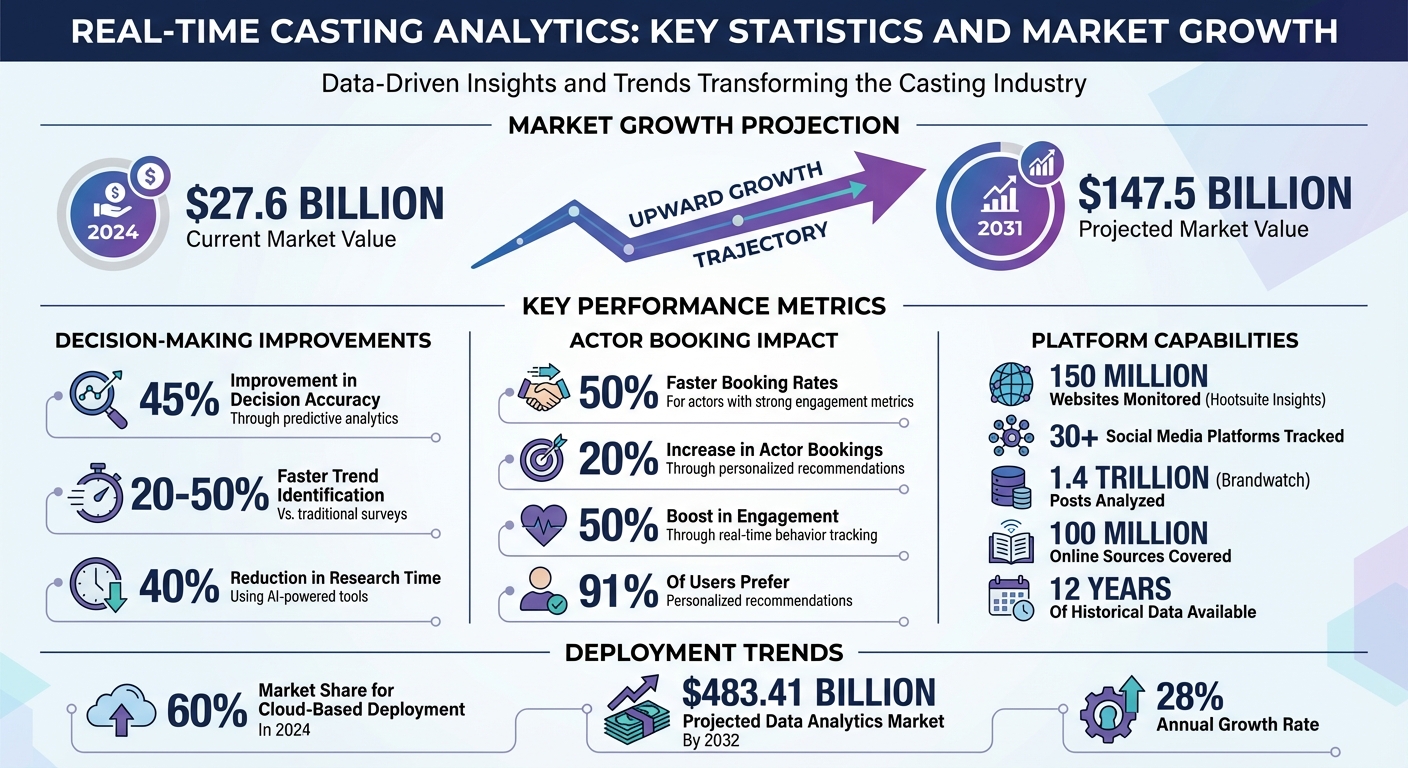
Real-Time Casting Analytics Market Growth and Impact Statistics 2024-2031
How Real-Time Engagement Data Affects Casting Decisions
Casting directors are increasingly turning to social media metrics - such as likes, shares, comments, sentiment analysis, and rewatch patterns - to gauge audience interest. These insights now complement traditional tools like auditions and resumes. For example, a surge in positive comments about an actor’s recent performance can signal growing popularity, while high share rates suggest viral potential, which can translate into a wider audience reach.
Key Engagement Metrics for Casting Analytics
Each engagement metric offers a unique perspective on audience behavior:
- Likes reflect basic interest in an actor or specific content.
- Shares expand visibility and indicate potential for organic buzz.
- Comments provide qualitative feedback, offering insights into what audiences love - or dislike - about a performance.
- Sentiment scores, derived from AI analysis of comment tone, help separate genuine enthusiasm from negative responses.
- Rewatch patterns, including video completion rates and repeat views, reveal sustained audience interest. Completion rates surpassing 80% often correlate with strong audience affinity.
Together, these metrics provide a comprehensive picture of casting demand. By tracking audience behavior in real time, casting directors can identify emerging trends 20–50% faster than traditional audience surveys. This ability to analyze data on the fly is reshaping how casting decisions are made.
Research Findings on Real-Time Engagement Impact
Studies highlight the growing influence of real-time data on casting. For instance, 91% of users prefer personalized recommendations based on real-time insights, leading to a 20% increase in actor bookings. Actors with strong engagement metrics experience booking rates that are about 50% faster, as casting directors prioritize talent aligned with current audience preferences.
Machine learning models play a key role in this process, analyzing massive datasets from social platforms to spot trends like shifts toward diverse casting or specific acting styles. These tools allow production teams to adjust casting strategies quickly and effectively.
Research rooted in Trust Theory and Social Influence Theory further shows that real-time engagement data can shape audience preferences, with dynamic monitoring improving forecast accuracy by 45%. Predictive analytics methods, such as decision trees to evaluate physical traits and regression analysis to assess the link between past experience and future success, turn raw engagement data into actionable insights. These tools help casting professionals stay in step with audience demands, proving the growing importance of real-time engagement in modern casting workflows.
Real-Time Engagement Tools for Casting Insights
Today’s casting professionals have access to platforms that track social media buzz and audience sentiment in real time. These tools dig deeper than traditional methods, offering insights into which actors are gaining attention and why. Let’s take a closer look at how Hootsuite Insights, Brandwatch, and CastmeNow bring these insights to life.
Hootsuite Insights
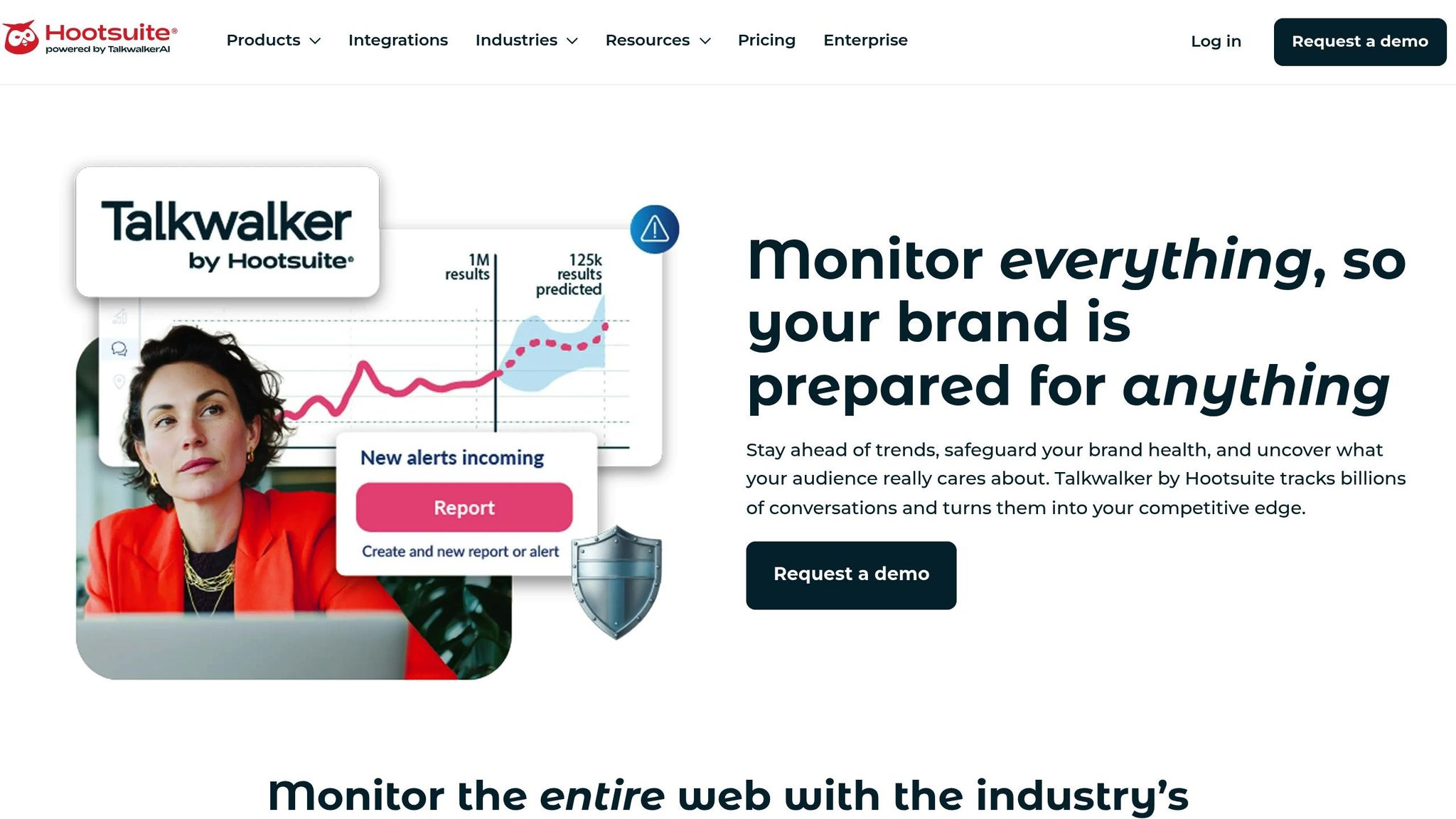
Hootsuite Insights, powered by Talkwalker, scans over 150 million websites and 30+ social media platforms like Instagram, TikTok, and YouTube. Its Blue Silk™ AI technology identifies mentions across text, images, videos, and even audio, then distills massive datasets into actionable insights. This process helps reduce research time by 40%.
"Hootsuite's listening feature is very helpful for audience feedback about our new show or movie." - Sreena S., Social Media Manager, Surinder Films Pvt. Ltd.
For casting directors, this translates to tracking real-time responses to an actor’s latest performance, spotting sentiment changes, and identifying rising stars. Its ability to analyze multimedia content is especially valuable for platforms where actors showcase their work. While Hootsuite focuses on real-time buzz, Brandwatch takes a broader, data-rich approach.
Brandwatch
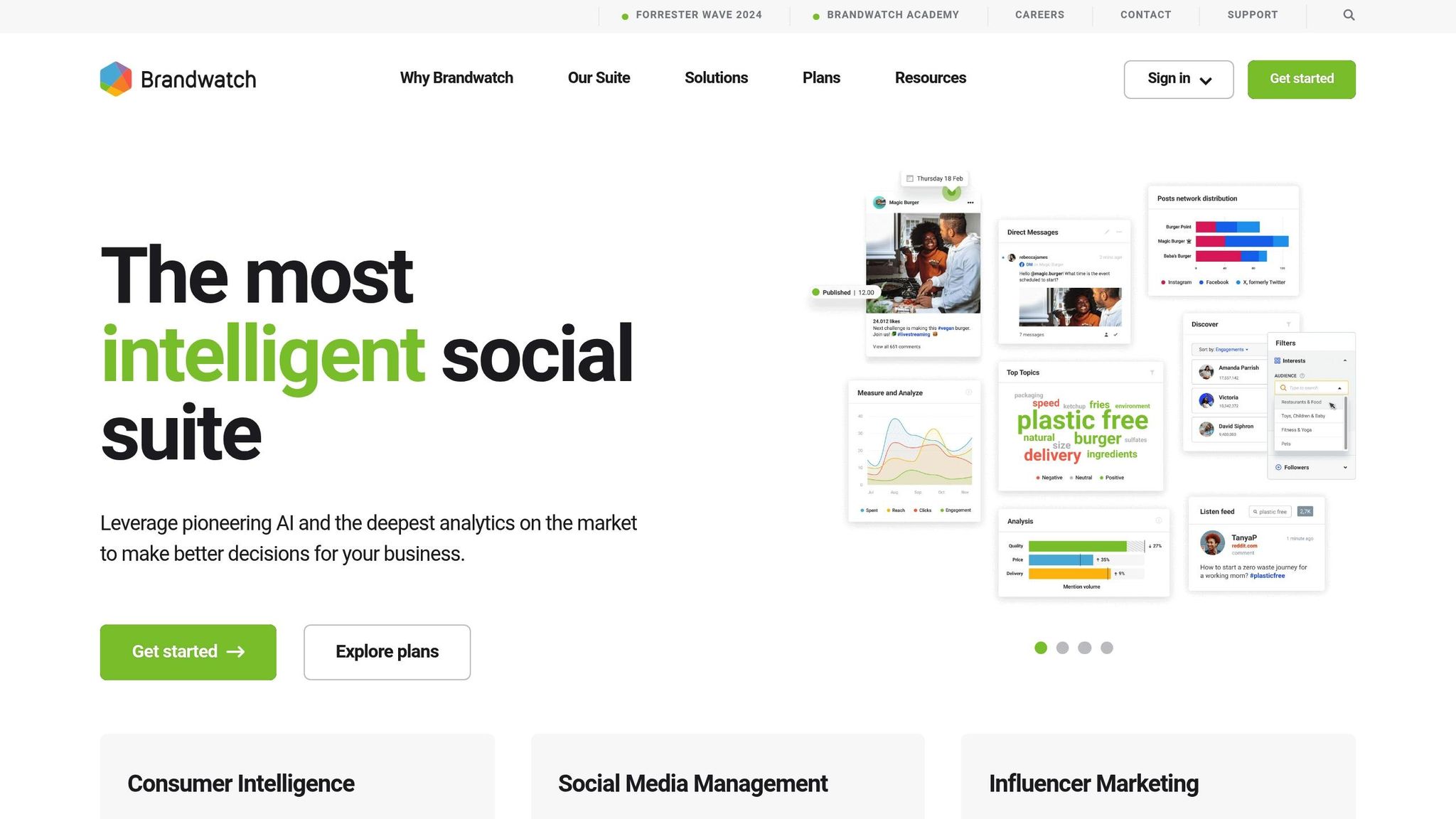
Brandwatch Consumer Intelligence dives into 1.4 trillion posts from 100 million online sources. With over 12 years of historical data, it helps casting teams uncover long-term trends in audience preferences and entertainment patterns. Its 48 Boolean operators allow precise searches by demographics, geography, or specific content types, providing a clear picture of what resonates with target audiences.
Users have rated Brandwatch an impressive 4.8/5 stars, highlighting its massive data pool and effective visualizations. For entertainment professionals, it’s a tool for forecasting trends in acting styles, character preferences, or talent profiles. For example, Pierre Fabre, a dermo-cosmetic company, used Brandwatch to monitor real-time audience feedback during a crisis. They later leveraged the tool to identify audience-specific keywords, which contributed to a successful product launch that earned "Product of the Year 2022" in France. While Brandwatch excels at trend analysis, CastmeNow shifts the focus to actor-driven analytics.
CastmeNow: Automated Role Applications
Unlike Hootsuite and Brandwatch, which cater to casting directors, CastmeNow is designed with actors in mind. It connects to casting profiles on platforms like Casting Networks and Actors Access, using AI role scoring to pair actors with roles that align with their profiles.
CastmeNow tracks metrics like response times, attendance, and booking trends to streamline casting workflows and improve accuracy. By automating applications, it empowers actors to submit to numerous roles effortlessly. For instance, one actor submitted to 484 roles in just two weeks, resulting in 19 auditions and 2 bookings. Another actor, with only six months of experience, submitted to 700 roles, securing 18 auditions and consistent self-tape requests every other day.
"Track actor behavior - response times, attendance and booking trends - to improve casting accuracy, speed workflows, cut costs, and find more reliable matches." - CastmeNow
The platform also helps actors refine their strategies by identifying casting directors who frequently call them in and tracking metrics like pay rates and callback patterns. For casting directors, these insights create a dependable talent pool by highlighting actors who are prompt, prepared, and professional. Additionally, its real-time feedback algorithms reduce bias by focusing on objective data like fit scores rather than subjective opinions.
Combining Real-Time Engagement Tools with Casting Platforms
Real-time engagement tools become far more impactful when paired with casting platforms rather than used in isolation. With the global data analytics market projected to reach $483.41 billion by 2032, growing at a 28% annual rate, integrating these tools is key to staying ahead. For actors and casting professionals, this kind of integration creates a dynamic feedback loop where social media buzz, audience sentiment, and casting opportunities inform and enhance one another in real time. This synergy paves the way for automated role matching and streamlines the entire casting process.
Automation Layers in Casting Platforms
Take CastmeNow, for instance. It acts as an automation layer that connects to well-established casting platforms like Casting Networks and Actors Access. Instead of replacing these platforms, it works alongside them, streamlining your daily casting search through automation based on an actor's preferences. By continuously monitoring new casting calls, leveraging advanced algorithms to assess role compatibility, and auto-applying to suitable opportunities, it saves actors countless hours of manual effort.
This solution directly addresses a pressing need for efficiency. With cloud-based deployment accounting for 60% of the market share in 2024 due to its flexibility and cost-effectiveness, it provides the perfect infrastructure for such automation tools. Actors can dedicate their time to honing their craft and preparing for auditions, while the system tirelessly scans for roles that fit their profile. On top of that, CastmeNow tracks key metrics like callback rates and time-to-booking, offering actors valuable insights to guide their career decisions. It’s a data-driven approach to casting that optimizes results for everyone involved.
Better Role Matching Through Data Integration
Automation is just the beginning - integrating real-time engagement data elevates role discovery to a whole new level. Studies show that 91% of people prefer brands that offer personalized recommendations, and personalization techniques can boost engagement by an average of 20%. By analyzing an actor’s application history, callback trends, and profile activity alongside current industry data, automation tools can uncover roles that might otherwise go unnoticed through manual searching.
Real-time behavior tracking further enhances engagement by at least 50%. By monitoring roles viewed, applied for, and callback rates, these systems build a detailed profile of an actor’s preferences. For example, if data indicates a surge in casting opportunities for a specific genre or roles requiring particular skills, the system can highlight these trends and recommend matching roles. This predictive edge helps actors stay ahead of market shifts, improving their chances of landing roles that align with their talents and the industry’s evolving needs.
Conclusion
Real-time engagement tools are reshaping the casting process by replacing guesswork with actionable insights. As the analytics market continues to expand, these tools are becoming essential for predicting trends and aligning actors with the right opportunities. Platforms like Hootsuite Insights and Brandwatch provide live updates on audience sentiment and casting trends, while predictive analytics have been shown to boost decision-making accuracy by 45%. These advancements highlight the growing role of automation in casting decisions.
Take CastmeNow, for example. This platform simplifies the casting process for actors by automating your acting audition submissions to services like Casting Networks and Actors Access, operating 24/7. Many actors have reported a noticeable increase in audition opportunities and reduced manual workload after using the platform. In one standout case, Ki'mari Lavender landed a role in New York City just 24 hours after signing up in December 2025, showcasing how precise matching can deliver quick results.
CastmeNow goes beyond simple automation by tailoring each application to fit specific role requirements, factoring in details like union status, pay, and project criteria. Its AI even crafts personalized submission notes and selects the most fitting headshots for each opportunity, ensuring that every application feels custom-made.
Additionally, the platform’s Audition Tracker provides valuable insights to refine career strategies. By analyzing callback rates, pay trends, and director engagement, actors can identify patterns - like excelling in particular genres - and adjust their approach accordingly. Real-time tracking has been shown to boost engagement by at least 50%, offering actors a clearer view of where the industry is heading and how they can stay ahead.
FAQs
Which real-time metrics matter most for casting decisions?
When it comes to casting decisions, a few real-time metrics stand out as game-changers. Submission volume tells you how many roles an actor has applied for, giving a clear picture of their activity level. Then there’s the response rate percentage, which tracks how often casting directors respond to those submissions - a great way to gauge engagement.
Metrics like the callback success rate and role booking success go deeper, offering insight into the quality of matches and the likelihood of landing roles. These numbers aren’t just stats; they help measure conversion potential in the casting process.
Platforms like CastmeNow take these metrics to the next level by delivering instant updates and analytics. This makes it easier for both actors and casting directors to make smarter, data-backed decisions on the fly.
How can actors use analytics without losing authenticity?
Actors can leverage analytics to boost their growth while staying true to themselves by keeping an eye on key metrics like submission volume, audition requests, and social media engagement. These numbers offer valuable insights, helping actors tweak their profiles and materials - like headshots or reels - in a way that’s smart and targeted. The goal isn’t to chase trends but to make adjustments that highlight their individuality.
Tools such as CastmeNow can be a game-changer, offering real-time feedback that enables actors to refine their approach. This way, they can improve their craft and strategy without losing the unique style and voice that set them apart.
What metrics should you track to prove ROI from real-time casting analytics?
To show the ROI of real-time casting analytics, keep an eye on essential metrics such as submission volume, audition requests, media requests, response rates, callback success rates, and booking outcomes. Tracking these provides a clear picture of performance and helps gauge industry demand with precision.