Diversity in Casting: Trends vs. Reality

The push for diversity in Hollywood has seen major setbacks despite years of progress. In 2024, white actors made up 67.2% of theatrical roles, a sharp increase from 59.6% in 2023. This is far from reflecting the U.S. population, where people of color represent 44.3%. Behind the scenes, the disparities are even worse - 91.5% of writers and 80% of directors were white. While films with diverse casts performed better financially, studios leaned on "safer" choices, prioritizing less diverse productions.
Key insights:
- Films with 41%–50% diverse casts earned a median of $234.6M globally, compared to $33.3M for less diverse casts.
- Women led 47.6% of roles in 2024, but budget disparities persist. Only one film by a woman of color had a $100M budget.
- Tools like CastMeNow help actors access roles but fail to address systemic biases.
Hollywood's promises of representation fall short without consistent action. The industry must close the gap between its public commitments and actual practices to reflect its audience and drive success.
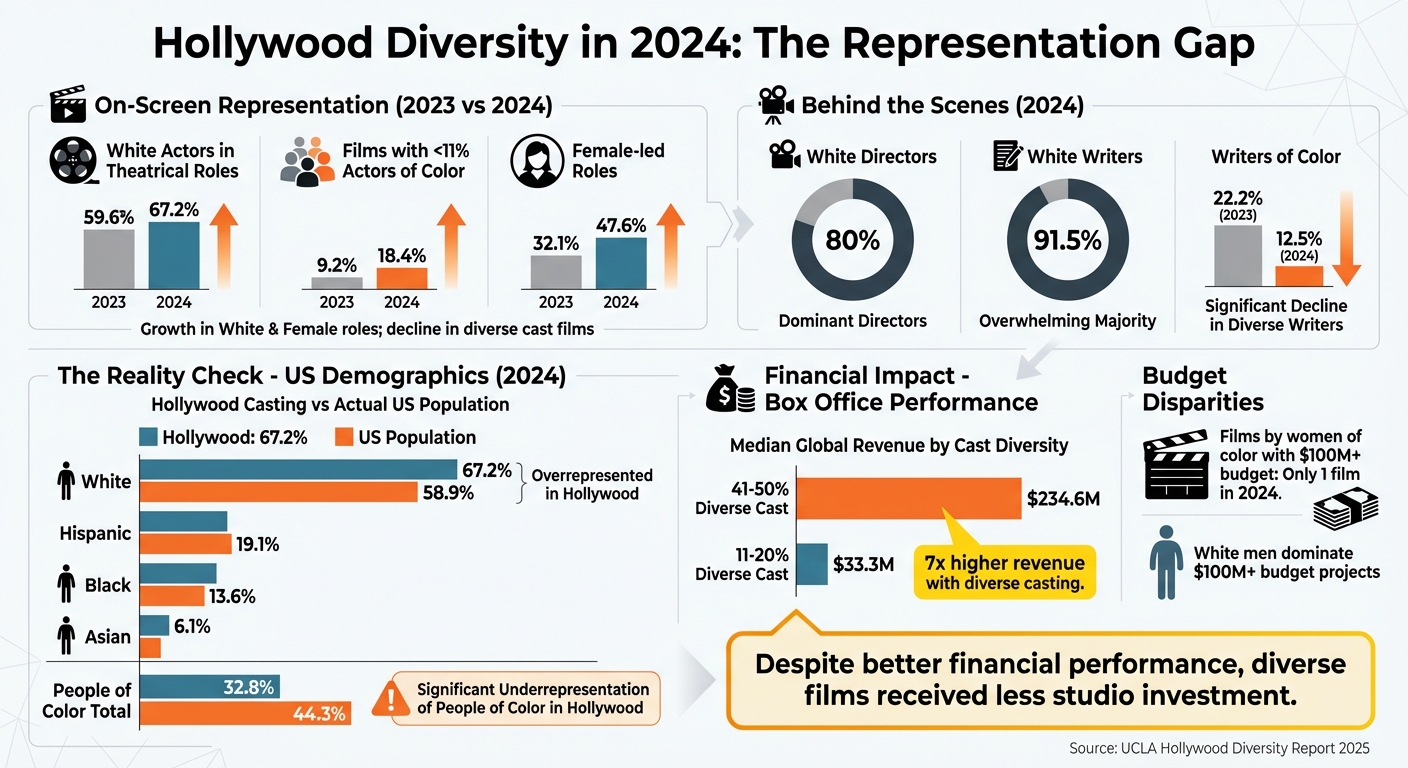
Hollywood Diversity Statistics 2024: Casting Representation vs US Demographics
Lupita Nyong'o: Diversity in Hollywood Should Not be "Trend" | Close Up
Representation Data and Historical Trends
The UCLA Hollywood Diversity Report series has been tracking representation in entertainment since the early 2010s, focusing on casting trends and metrics. Produced by the UCLA Entertainment and Media Research Initiative, these reports highlight both progress and challenges in the industry's push for diversity.
From 2010 to 2023, there were small but steady gains for actors of color in television and film. Women, as well as Black, Hispanic/Latino, and Asian actors, began to secure more lead roles over time.
However, the UCLA Hollywood Diversity Report 2025, Part 2: Streaming revealed a troubling shift. In 2024, the number of lead roles held by people of color dropped, and directors from underrepresented backgrounds saw a decline - a noticeable setback after years of gradual improvement. This regression stands in stark contrast to the forward momentum observed in previous years.
Historically, progress in Hollywood diversity has been anything but consistent. Gains have often been short-lived, and the 2024 data underscores how fragile these advancements can be without ongoing institutional support.
These shifts in representation reflect broader societal influences, such as political trends, audience preferences, and studios' commitment to funding diverse stories. The growing gap between Hollywood's public promises about diversity and the actual representation on screen raises questions about the industry's true dedication to change.
1. Hollywood Casting Trends
Representation Data
The 2024 numbers reveal some stark shifts in Hollywood's casting landscape. The percentage of white actors in theatrical roles rose to 67.2%, a noticeable jump from 59.6% in 2023. Films featuring casts with less than 11% actors of color also saw a sharp increase, doubling to 18.4% - a level not seen since 2017. Behind the scenes, the disparities were even more pronounced: 80% of directors and a staggering 91.5% of writers were white. Meanwhile, the presence of writers of color took a steep dive, dropping from 22.2% in 2023 to just 12.5% in 2024.
For women, the story was somewhat different. Female-led roles surged from 32.1% in 2023 to 47.6% in 2024. Still, this progress came with limitations. White women directors and lead actors were largely restricted to smaller productions with budgets under $10 million or $20 million, while white men dominated projects with budgets exceeding $100 million. In 2024, only one film directed by a woman of color managed to secure a budget of $100 million.
These trends underscore the gap between Hollywood’s public commitments to diversity and the actual outcomes. The imbalance not only affects representation on screen but also contributes to inequitable opportunities across the industry, highlighting the need to weigh casting automation vs manual applications when navigating these systemic barriers.
Impact on Industry Outcomes
The financial performance of films paints a contrasting picture. Movies with casts that were 41%–50% diverse achieved a median global box-office revenue of $234.6 million. In comparison, films with only 11%–20% diversity brought in a median of just $33.3 million. Two major hits in 2024 - "Godzilla x Kong: The New Empire" and "Venom: The Last Dance" - featured casts that were 41%–50% people of color, leading global box-office earnings. Meanwhile, "Inside Out 2" emerged as the highest-grossing film of the year, driven heavily by support from women of color. These audiences made up the majority of ticket buyers for 12 of the top 20 films, including seven of the top 10.
"For the studios, it seems that it wasn't about investing in what our data has shown to be profitable. They went with what they considered safe."
This insight from Darnell Hunt, UCLA Executive Vice Chancellor and Provost, highlights a disconnect. Despite clear evidence that diverse films perform well financially, studios appear hesitant to fully embrace these opportunities. As a result, audiences - especially women and people of color - are less drawn to wide releases that fail to reflect their identities.
2. U.S. Demographics and Casting Platforms (e.g., CastMeNow)
Taking a closer look at U.S. demographics helps shine a light on the systemic issues behind casting disparities in Hollywood.
Representation Data
According to U.S. Census projections for 2024, white Americans are expected to make up 58.9% of the population, while Hispanics account for 19.1%, Blacks for 13.6%, and Asians for 6.1%. Yet, casting data from the same year shows a disproportionate dominance of white actors, highlighting a clear gap between the nation's diverse population and the opportunities available in the entertainment industry.
Platforms like CastMeNow, which use automated systems to match actors with roles based on casting directors' specifications, often mirror these disparities. Instead of adapting to the country’s changing demographics, these tools tend to reinforce long-standing industry norms. As a result, actors from underrepresented groups continue to face limited opportunities.
Trends Over Time
Historical data from UCLA studies confirms that the disconnect between U.S. demographics and casting representation has been a persistent issue. Automation tools, such as CastMeNow, rely on criteria rooted in traditional casting practices, which perpetuates these imbalances. By aligning with outdated standards, these systems widen the gap between the industry’s promises of diversity and the reality of its practices.
Pros and Cons
Efforts to improve diversity in the entertainment industry are gaining momentum, but the reality often falls short of the promises. Examining both the progress and the setbacks reveals where strides are being made and where obstacles remain firmly rooted.
In 2023, films featuring casts with 31–40% BIPOC representation achieved the highest median global box office earnings. For the first time, films with over 50% BIPOC casts dominated among top earners. These numbers challenge the outdated belief that diverse casting is a financial gamble.
But the challenges are far from over. For instance, lead roles for women dropped from 38.6% in 2022 to 32.1% in 2023. On top of that, 61.3% of films featured no disabled actors at all. Budget disparities also persist: women directors often find themselves capped at $50 million, while BIPOC directors typically face a ceiling of $100 million. Meanwhile, the largest blockbuster budgets continue to go to white male directors.
"We want and deserve to see people like us represented truthfully and fairly... And we need to see people who are not like us... so that we can better understand each other"
These statistics underscore the potential of diversity to drive financial success, but they also highlight how deeply entrenched systemic inequalities remain.
Technology is beginning to play a role in addressing these issues. Tools like CastMeNow, for example, simplify the process of applying for roles, helping underrepresented actors save time previously spent on manual submissions. However, while these platforms improve access, they don’t tackle the biases that often shape casting decisions.
True transformation requires more than just technological fixes. It calls for a fundamental shift in how roles are conceived, budgets are allocated, and casting decisions are made. Technology can be part of the solution, but lasting change will only come when it’s paired with a genuine commitment to equity at every level of the industry.
Conclusion
Casting in Hollywood continues to fall short of reflecting U.S. demographics. Recent data paints a clear picture of this misalignment, both on-screen and behind the scenes, where representation gaps persist. Interestingly, films with more diverse casts achieved a global median revenue of $234.6 million, compared to just $33.3 million for films with limited diversity - proving that inclusive casting isn't only a moral imperative but also a financial advantage.
The UCLA Hollywood Diversity Report 2025 serves as a crucial tool for measuring these disparities and holding the industry accountable. It highlights areas where progress has stagnated - or even regressed. While tools like CastMeNow help underrepresented actors access opportunities by streamlining acting role applications, they alone cannot dismantle the systemic biases that dominate the industry. As Ana-Christina Ramón pointed out, 2024 marked a troubling retreat from earlier diversity gains by studios.
For meaningful change, studios must treat diversity as a core, enduring strategy rather than a fleeting trend. Michael Tran, a doctoral candidate at UCLA, put it best:
"The key to long-term sustainability - and profits - is the continued progress in showing diverse characters and stories, not stalling or falling backward".
The evidence is undeniable. The future of representation in Hollywood hinges on the industry's willingness to act decisively and consistently.
FAQs
Why did the percentage of white actors in theatrical roles increase in 2024?
The rise in the percentage of white actors cast in theatrical roles in 2024 seems tied to an uptick in films focusing on white protagonists. At the same time, representation for other racial and ethnic groups saw a decline, shedding light on ongoing disparities in casting practices.
This pattern highlights the disconnect between efforts to promote inclusivity in the entertainment industry and the actual progress in on-screen representation, emphasizing the continued challenges in creating equal opportunities for actors from all backgrounds.
How does casting diverse actors affect a film's success?
Diverse casting has a proven track record of driving a film's financial success. Research shows that movies with inclusive casts and diverse teams behind the camera tend to reach wider audiences, translating to better box office numbers and streaming performance. This trend highlights an increasing appetite for storytelling that feels relatable and genuine.
But diversity isn’t just about meeting social expectations - it’s also a savvy business move. Films that showcase diverse talent, both on-screen and off, frequently exceed performance predictions, showing that representation can directly contribute to profitability for studios and investors.
What challenges do tools like CastMeNow face in promoting diversity in casting?
Tools like CastMeNow make it easier for actors to apply for roles by automating submissions and boosting their visibility. While these platforms open doors for actors from various backgrounds, they still function within an entertainment industry shaped by systemic biases and uneven representation. The deeper structural challenges and societal stereotypes that influence casting decisions remain untouched by these tools.
Automation certainly streamlines the process, but it doesn’t alter the preferences of casting decision-makers or eliminate the obstacles faced by underrepresented groups. While there has been progress in improving diversity, it’s happening slowly, and public perception often exaggerates how much has actually changed. Platforms like CastMeNow are a positive step toward creating more opportunities, but achieving genuine representation will require broader transformations within the industry.