Global vs. Regional Reports: Which to Use?

Understanding whether to use global or regional casting reports depends on your career goals and location. Here's the quick breakdown:
- Global Reports: Focus on international projects like Netflix or Amazon Prime productions. Ideal for actors seeking worldwide exposure and roles in big-budget, cross-border productions. Great for multilingual or diverse performers.
- Regional Reports: Target specific local markets (e.g., Atlanta, New York). Best for actors building experience in smaller, community-focused productions or those aiming to establish themselves as local hires.
Key Differences:
- Scope: Global reports cover international trends; regional reports focus on local opportunities.
- Access: Global platforms like Spotlight are open to broader talent pools, while regional reports may require local agents or connections.
- Insights: Global reports highlight trends like remote auditions; regional reports detail tax incentives and market-specific practices.
Quick Comparison:
| Feature | Global Reports | Regional Reports |
|---|---|---|
| Coverage | Worldwide | Specific cities or regions |
| Focus | International trends and projects | Local productions and niches |
| Best For | Global career seekers | Local market building |
| Access | Open via global platforms | Often tied to local agents |
Choose global reports for international ambitions and regional reports for local growth. Combining both and deciding between manual vs automated casting submissions can maximize opportunities.
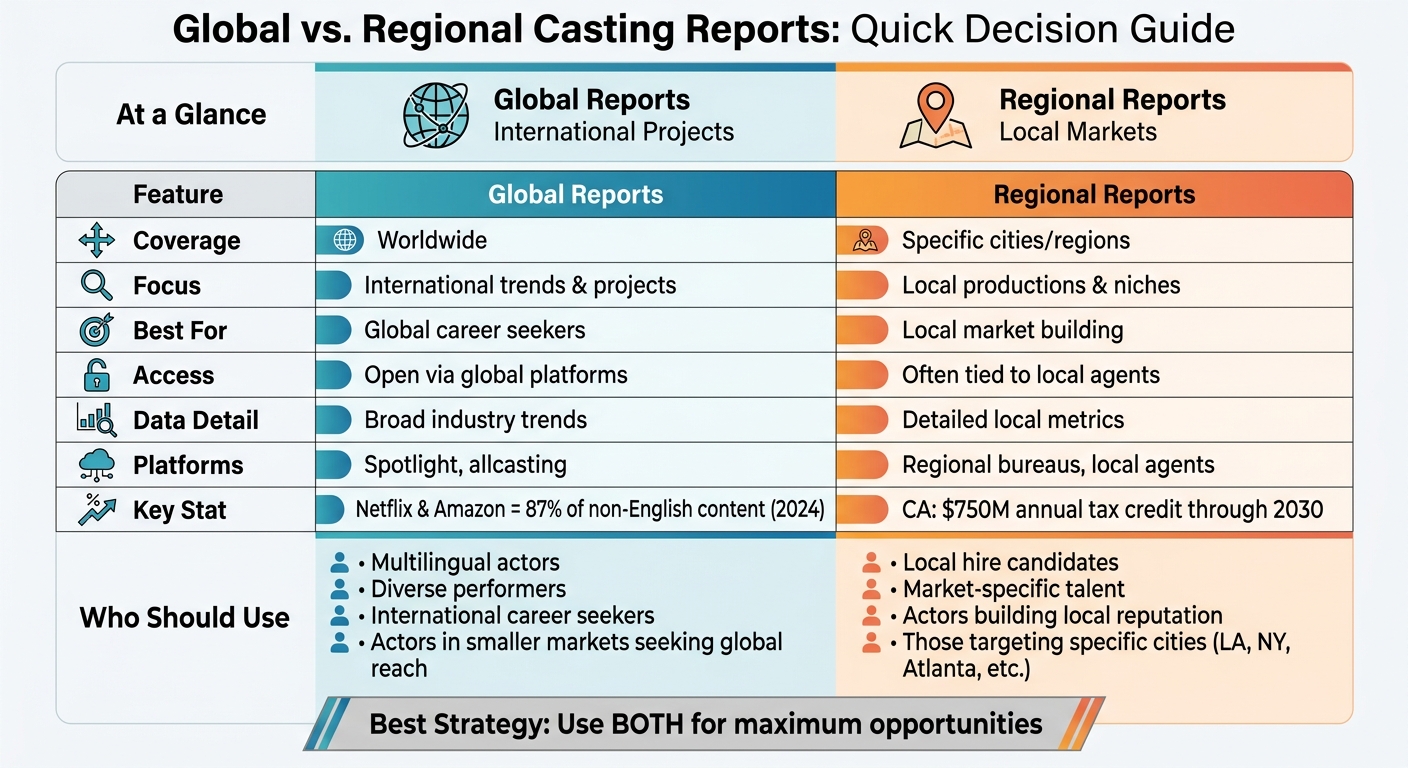
Global vs Regional Casting Reports Comparison Chart for Actors
What Are Global Casting Reports?
Definition and Purpose
Global casting reports provide a comprehensive view of talent discovery and industry trends across the world. They break down traditional barriers like geography and time zones, creating what casting director Jigar Shah calls a "borderless audition room". Instead of focusing on a specific city or region, these reports pull data from diverse locations - spanning cities like Montreal, Manila, and London - to showcase how casting operates on a global scale. They also spotlight the growth of international micro-productions, where actors from countries like Canada, the US, China, Turkey, and the UK collaborate on the same project.
Main Features and Data Types
These reports focus on broad industry trends rather than individual casting calls. They analyze key metrics such as the efficiency of remote casting, evolving standards for digital communication, and self-tape submission practices. They also explain how to use Casting Networks for role matching to streamline these digital workflows. Emerging formats, like vertical dramas designed for short-form storytelling, are also highlighted. Additionally, the reports track trends like multi-country filming and automated audition processes. For example, productions now span locations like Hungary, Turkey, and Canada. One standout statistic shows that Netflix and Amazon Prime were responsible for 87% of all non-English content available in the first half of 2024. At the same time, the reports predict a 20% drop in programming spend in North America by 2028, even as investments in international markets continue to grow.
Who Should Use Global Reports?
These reports are especially useful for actors looking to build international careers in a globalized entertainment industry. They’re particularly valuable for multilingual and culturally diverse performers. Actors in smaller markets can also benefit, as local-language productions are becoming more prominent.
"Online casting has taken away borders and time zones. It's democratized the process completely. The reach and visibility is massive!"
- Jigar Shah, Casting Director
For actors outside major hubs, global reports can uncover opportunities in emerging markets and provide insights into the increasing reliance on remote auditions. This global perspective offers a stark contrast to the localized focus of regional reports, making it an essential tool for navigating today’s casting landscape.
sbb-itb-daa9c42
What Are Regional Casting Reports?
Definition and Purpose
Regional casting reports take a closer look at specific geographic markets rather than presenting a broad national or global overview. For instance, the "NY market" includes New York City, New Jersey, and parts of Pennsylvania and Connecticut. These reports focus on market-specific niches, such as Chicago’s stage acting scene or Spanish-language productions in Miami.
While global reports highlight overarching trends, regional reports let actors assess how those trends apply to their local area or state. With production decisions increasingly tied to state-level tax incentives rather than traditional industry hubs, having a localized perspective is becoming more important than ever.
"We looked at these national trends, but that could differ for each community. And I think it's important to understand how the narrative might play out in a local setting."
- Layla O'Kane, Senior Economist, Lightcast
This localized focus allows for a deeper understanding of the specific metrics and trends shaping regional markets.
Main Features and Data Types
These reports stand out for their detailed insights into local production activity. They dive into metrics like the number of active casting calls, competition levels, and the types of projects dominating a market - whether it’s regional commercials, branded content, independent films, or local TV productions. Local-hire eligibility and tax incentives also play a major role, influencing where productions choose to film and cast talent.
For example, California has expanded its Film & TV Tax Credit program to $750 million annually through 2030 to retain high-budget productions in Los Angeles. Meanwhile, New York’s updated film and TV incentives are expected to boost production activity by 5–12% in 2026.
Tax incentives are also driving market shifts. Georgia will offer a new post-production tax credit starting in 2026, providing an additional 20–35% for qualifying work. In San Antonio, Texas, combined rebates for productions can go up to 45%. These developments highlight growth in emerging markets like Pennsylvania and Ohio, which are introducing new tax credits for 2026.
| Market Region | Primary Focus/Niche | 2026 Growth Driver |
|---|---|---|
| Los Angeles | Film, TV, and Franchises | $750M annual tax credit expansion |
| New York | Stage (Broadway), Comedy, Episodic TV | 5–12% projected production growth |
| Atlanta | Blockbusters, Streaming Series | New 20–35% post-production credit |
| Miami | Spanish-language, Commercials, Modeling | Emerging film/TV growth spurt |
| Chicago | Theater, Stand-up, Improvisation | Enhanced production tax credits |
Who Should Use Regional Reports?
These reports are particularly helpful for actors targeting specific cities or states. They’re a must-have for performers aiming to establish themselves as local hires - actors who don’t require productions to cover relocation or housing costs.
Regional reports are also valuable for actors weighing the pros and cons of established hubs versus emerging markets. While cities like Los Angeles and New York offer more opportunities, they also come with intense competition and higher living expenses. On the flip side, markets like Las Vegas, Miami, and New Jersey offer easier access to bookings and less competition for newer talent. Instead of relying on a city’s reputation, actors can use these reports to evaluate the consistency of casting opportunities and streamline your daily casting search in any given market. This kind of localized insight can be a game-changer for strategic career planning.
Comparing Global and Regional Reports
Side-by-Side Comparison
To better understand the nuances between global and regional casting reports, let’s break down their key differences. These reports vary significantly in terms of scope, level of detail, and how actors can access them. Global reports focus on international platforms like Netflix, Amazon, and Apple TV+, often covering productions that span multiple countries. On the other hand, regional reports zero in on specific markets - such as the UK, France, or Italy - providing detailed insights into local industry practices and competition.
Here’s a closer look at how they compare:
| Factor | Global Casting Reports | Regional Casting Reports |
|---|---|---|
| Data Granularity | Broad; highlights "types", cultural diversity, and multi-language skills | Detailed; focuses on local training, regional agents, and language fluency |
| Geographic Coverage | Worldwide; includes major streaming hubs and international co-productions | Specific to countries or cities (e.g., UK, France, Eastern Europe) |
| Reporting Frequency | Updated in real-time via global casting platforms | Often tied to local events, associations, or project timelines |
| Cost & Access | Subscription-based platforms (e.g., Spotlight, allcasting); open to unrepresented talent | Frequently restricted to actors with local agents or access to regional bureaus |
| Career Relevance | Best for actors pursuing roles in international streaming or global productions | Crucial for building a strong local reputation and career foundation |
The scale difference is worth noting: Spotlight, a global casting platform, features over 70,000 actors, while the Paris market includes only about 16,000 to 18,000 performers. These distinctions illustrate how each report serves actors with different career objectives.
Wide Coverage vs. Detailed Focus
Global reports provide a broad overview, capturing trends in international markets and opportunities with major streaming platforms. They focus on traits like authenticity and a global appeal, which are often prioritized over theatrical polish. This makes them a great resource for actors targeting high-budget streaming projects or international feature films.
Regional reports, however, drill down into specific market details. They highlight the need for agents in some regions (like the UK) or self-representation via social media in others (such as Italy and Eastern Europe). These reports also reveal local casting preferences. For instance, casting directors in Paris often prefer in-person auditions due to the smaller talent pool, whereas self-tapes are more common in Italy and Germany to manage higher submission volumes.
"Do the craft in your own country first. You need to understand who you are as an actor and work out that bit first."
- Victor Jenkins, Casting Director
This contrast underscores why actors must align their choice of report with their career goals and the markets they aim to enter.
Cost and Access Differences
Another key difference lies in how actors access these reports. Global casting platforms rely heavily on digital tools and self-tapes, making it possible for actors to audition for international roles without traveling. By 2026, remote opportunities will likely continue to enable actors to build careers without being tied to traditional industry hubs.
Regional reports often require navigating unique entry points depending on the market. For example, in the UK, agents act as gatekeepers, while in Eastern Europe, actors frequently use local work bureaus or even Facebook-based casting groups. Costs include not only subscription fees or agency commissions but also the time and effort needed to adapt to local industry norms. For actors aiming to break into global markets, the advice is clear: emphasize language skills and cultural backgrounds in their profiles, as these attributes are highly valued by international casting directors.
How to Choose the Right Report Type
Picking the right report type hinges on where you are in your career - whether you're aiming for a global stage or focusing on building a strong local foundation.
When to Use Global Reports
If you're eyeing an international career or seeking roles with global platforms like Netflix, Amazon, or Apple TV+, global reports are your go-to. These reports spotlight worldwide trends, such as the shift toward authenticity over overly polished performances. They’re especially helpful if you’re planning to transition between major markets, like moving from the UK to the US or navigating different European countries. Global reports give you the big-picture insights you need to make smart decisions.
To stay competitive, make sure your Spotlight or allcasting profiles are up-to-date. Include current photos, detailed language skills, and your cultural background - casting directors often use these filters when searching for talent.
When to Use Regional Reports
Starting locally can be a smart move before taking on international markets. Casting director Victor Jenkins emphasizes this approach:
"Do the craft in your own country first. You need to understand who you are as an actor and work out that bit first".
Regional reports provide insights into local casting practices and immediate opportunities. For instance, in Paris, where there’s a smaller talent pool of 16,000 to 18,000 actors, in-person auditions are still the norm. Meanwhile, larger markets are leaning more on self-tapes. These reports also highlight local gigs - like commercials, indie films, or training videos - that can help build your credits and reel, often in areas with lower living costs.
They’re also useful for understanding market-specific norms. For example, in the UK, having an agent is standard, while in Eastern Europe, self-representation through social media is more common. Aligning your strategy with these insights can set the stage for future international opportunities.
Using Both Report Types Together
Combining global and regional reports is often the smartest strategy. Global reports help you track overarching industry trends - like the rise of non-binary roles or the growing reliance on remote auditions. Regional reports, on the other hand, help you zero in on local opportunities, such as specific theaters, production hubs, or advocates who can guide you through these changes.
Tools like CastmeNow (https://castmenow.co) can streamline your efforts by matching your Casting Networks and Actors Access profiles with roles that suit your skills, saving you valuable time.
It’s also crucial to maintain detailed profiles on both global platforms (like Spotlight) and region-specific ones (like e-talenta for Europe). Casting directors often search these databases for specific skills and languages. Talent manager Natasha Matallana Marken sums it up well:
"I prefer, actually, to meet an actor whose very happy where they are, where ever that is, and where their lives are being fulfilled".
Conclusion
When it comes to choosing between global and regional reports, the best option depends on your career objectives. Global reports offer a window into international streaming projects and worldwide trends, while regional reports focus on strengthening your presence in local markets and increasing opportunities for local hires. Your decision should align with where you see your career heading.
Self-taping has made location less of a barrier for initial auditions, but there’s still a need to consider whether you can travel for in-person callbacks in major production hubs. Talent manager Natasha Matallana Marken from Rebel Creative highlights this shift:
"The initial step, with self-tapes being the norm, it no longer really matters. I prefer, actually, to meet an actor whose very happy where they are, where ever that is, and where their lives are being fulfilled".
For the most comprehensive approach, consider using both types of reports. Global reports keep you updated on industry-wide changes and international opportunities, while regional reports help you zero in on immediate, local openings. This strategy ensures you maintain a balance between staying competitive globally and thriving locally.
To make your audition process smoother, tools like CastmeNow (https://castmenow.co) can help. This AI-powered assistant links to your Casting Networks and Actors Access profiles, which you can improve by optimizing your casting profile, streamlining your acting role applications so you can dedicate more time to honing your craft.
FAQs
Can I use global reports if I’m not based in a major hub?
Global reports can be incredibly helpful, even if you're not based in a major hub. They shed light on industry trends, identify emerging markets, and spotlight new production hubs - opening doors to opportunities worldwide. While these reports provide a broad overview, regional reports dive into local details. Using both together gives you a more complete picture of the industry, regardless of where you're located.
How do I know if I qualify as a local hire in a region?
To be considered a local hire, your proximity to the filming or casting location plays a key role. Generally, clients prefer talent located within 30 minutes to about 1-2 hours of the site. If you're more than 3 hours away or need to fly in, you probably won't qualify. Clients prioritize individuals who can show up consistently without extensive travel arrangements.
What should I update on my casting profiles for global roles?
To make your profile stand out, ensure it includes accurate details about your physical traits, relevant skills, and current media assets like headshots or demo reels. Updating this information regularly keeps you aligned with current industry demands and increases your chances of matching casting opportunities.