
How Behavioral Data Improves Casting Matches
Track actor behavior—response times, attendance and booking trends—to improve casting accuracy, speed workflows, cut costs, and find more reliable matches.


Behavioral data is transforming the way casting decisions are made by focusing on actions rather than appearances or static profiles. Unlike headshots and resumes, which are curated snapshots, behavioral data tracks metrics like response times, punctuality, and reliability over time. This approach helps casting teams identify actors who consistently meet expectations, reducing risks like no-shows or missed deadlines.
Key benefits include:
- Improved precision: Metrics like self-tape punctuality and attendance rates offer a clearer view of actor reliability.
- Faster workflows: Automation tools, such as CastmeNow, streamline processes by prioritizing high-performing actors.
- Cost savings: Reliable matches reduce the need for reshoots or last-minute recasting, saving time and money.
- Long-term insights: Tracking behavioral patterns over time helps build stronger professional relationships.
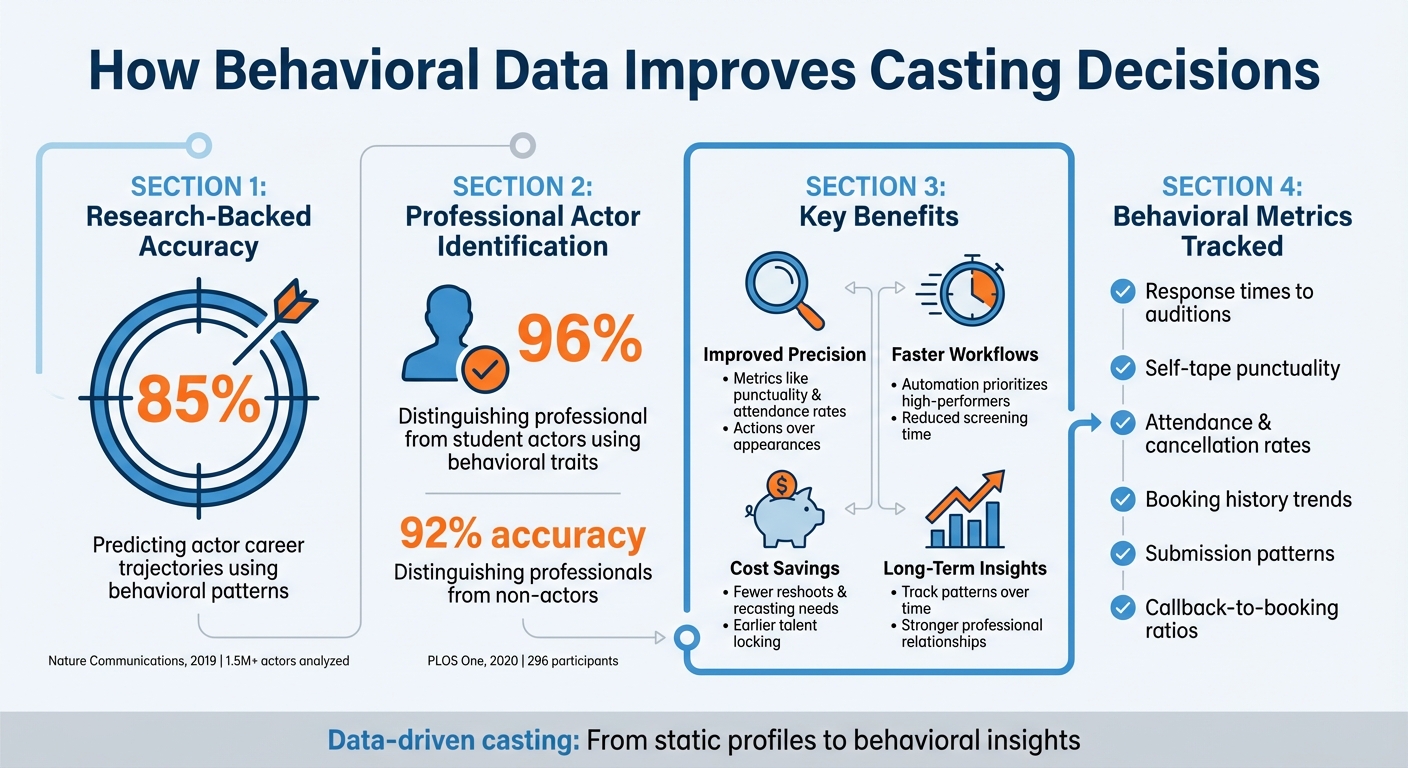
How Behavioral Data Improves Casting Decisions: Key Statistics and Benefits
Research on Behavioral Data and Match Quality
Behavioral Patterns Predict Performance
Research shows that behavioral patterns often provide better insights into casting success than static credentials. For instance, an actor's booking history and activity trends can reveal their reliability and productivity over time. A notable study achieved an impressive 85% accuracy in predicting whether an actor's peak productivity had passed. Published in Nature Communications in May 2019, researchers Oliver E. Williams, Lucas Lacasa, and Vito Latora analyzed data from IMDb, covering the career profiles of 1,512,472 actors and 896,029 actresses from 1888 to 2016. They discovered that acting careers typically follow a pattern of alternating bursts of high productivity ("hot streaks") and quieter periods ("cold streaks"). Using these patterns, they developed a machine learning model capable of predicting career trajectories with high precision.
This research highlights how behavioral patterns can be used to classify actors into distinct categories based on their professional traits.
Grouping Actors by Behavioral Traits
Psychological traits offer another layer of insight into an actor’s professional standing. A 2020 study examined 104 professional actors, 100 student actors, and 92 non-actors, identifying traits such as high Originality and Volatility as key markers of professional actors. When combined with age, the model could distinguish professionals from student actors with 96% accuracy and from non-actors with 92% accuracy.
"Professional actors were specifically marked by high levels of Originality, Volatility, and Literary Activities." - Dumas et al., PLOS One
This approach suggests that grouping actors by measurable behavioral traits - rather than traditional demographic categories - can give casting teams a more refined way to match talent with roles.
Using Real-Time Behavioral Metrics
Real-time data adds a dynamic edge to casting decisions. Metrics tracking an actor's current activity and responsiveness provide immediate insights into their availability and engagement. For example, the 2019 Nature Communications study noted a "rich-get-richer" effect: actors who worked in the previous year were more likely to secure work in the current year. This trend underscores the value of focusing on real-time engagement signals to identify active and responsive talent.
Modern casting systems now incorporate these real-time insights, streamlining workflows and improving the accuracy of role matching while minimizing delays and missed opportunities.
How Casting Systems Use Behavioral Data
Collecting and Processing Behavioral Data
Modern casting systems have evolved to go beyond headshots and résumés, diving into behavioral data to create more detailed actor profiles. These systems track various actor-related behaviors, such as response times to audition invites, how often and when they submit for roles, their acceptance or decline patterns, preferences for specific genres or roles, geographic flexibility, attendance rates, cancellation history, and callback-to-booking ratios. Platforms like Casting Networks and Actors Access gather this data through API integrations, scheduled data pulls, or secure scraping. They record events like submission creation, audition confirmations, and offer acceptances, all with precise timestamps.
Once gathered, these raw data points are processed into actionable performance metrics. For example, systems calculate median response times (in minutes), weekly submission volumes, submission-to-audition conversion rates, audition-to-booking ratios, and reliability scores based on attendance rates. They also assess role preferences by analyzing the percentage of submissions for specific genres, budget ranges (in USD), or union versus non-union jobs. Engagement scores track how frequently and recently actors interact with casting opportunities. All these metrics are stored in feature tables, organized by actor ID, and updated hourly or daily. This near-real-time data enables casting systems to make faster, more precise decisions about role matches and submission timing.
Building Predictive Models for Role Matching
Casting systems use supervised machine learning models to predict outcomes like audition invitations, callbacks, and bookings. These models rely on a mix of behavioral metrics - such as response times, reliability, and booking trends - and static attributes like age, location, and skills. Research shows that behavior-based features are more accurate predictors of engagement and performance than demographic data alone. This is consistent with findings in other industries, where behavioral insights often outperform static trait-based models. Algorithms like gradient boosted trees or random forests analyze behavioral patterns (e.g., consistently quick responses to comedy roles in Los Angeles) and generate a match score for each actor-role combination. Casting teams and automation tools then use these scores to prioritize submissions.
Historical data plays a key role in training these models. For example, past records of actors, roles, and outcomes provide positive examples (roles booked or auditioned for) and negative examples (roles applied for but not selected or ignored entirely). To avoid data leakage, only information available before the decision point is used - such as booking rates over the previous 6–12 months or average response times during that period. Role-specific success metrics are also factored in. Models are evaluated using metrics like AUC (area under the curve), precision among top candidates, and improvement over baseline matching methods. These models are continuously retrained with fresh data to stay aligned with shifting industry trends and individual actor behaviors, ensuring casting decisions remain effective and timely.
Automation Tools That Apply Behavioral Insights
Automation platforms like CastmeNow (Cast Me Now) build on existing casting systems, acting as an enhancement layer rather than a replacement. These tools monitor an actor's submissions, accepted roles, and declined auditions to develop a behavioral profile. For example, CastmeNow integrates with platforms like Casting Networks and Actors Access, tracking which roles an actor accepts, where they secure auditions, and what they book. Using this behavioral history, the system fine-tunes matching rules to better align with the actor's strengths and patterns.
If an actor frequently books dramatic co-star roles in New York but struggles with comedic leads, CastmeNow adjusts its recommendations to prioritize roles they’re more likely to land. It even considers the actor’s typical availability and response patterns, timing submissions when they’re most likely to reply quickly. This improves their reliability in the eyes of casting directors while maximizing their exposure around the clock. The tool continuously adapts to changes in the actor’s behavior, ensuring that matches remain relevant and effective over time. By leveraging these insights, automation tools like CastmeNow help actors and casting professionals work smarter, not harder.
Benefits of Using Behavioral Data in Casting
Building on earlier insights, incorporating behavioral data into casting offers clear advantages in accuracy, efficiency, and long-term success.
More Accurate Role Matches
Behavioral data shifts casting decisions from relying on claims to focusing on proven actions. By tracking real-world behaviors - like response times, self-tape submissions, attendance, and booking trends - casting systems can predict performance based on actual history rather than static traits alone. Research highlights that behavioral patterns are better indicators of real-world success compared to static attributes.
This approach minimizes mismatched auditions for actors and ensures casting directors and producers get shortlists filled with candidates whose behavioral records align with the specific demands of a role. For example, actors with a history of punctuality and reliability are flagged for high-pressure shoots, reducing risks like no-shows or delays in production.
Platforms like CastmeNow (Cast Me Now) take this a step further by auto-matching actors based on their past bookings, engagement, and reliability metrics. Instead of relying solely on profile keywords, the system uses tracked actions to refine matches and improve accuracy.
Faster Casting and Cost Savings
Beyond improving matches, behavioral data accelerates the casting process and reduces costs. Teams can prioritize actors with proven track records of punctuality and consistent performance, cutting down on screening time and administrative overhead. Reliable matches also reduce the need for additional audition rounds, saving time and money.
Cost savings extend further by avoiding expensive reshoots or mid-production recasting. With behavioral insights, productions can confidently select actors who have a history of delivering under tight schedules and challenging conditions. This is especially critical in U.S. markets, where union rates, location fees, and crew expenses can make reshoots prohibitively expensive. Streamlined casting also allows producers to lock in talent earlier, safeguarding shooting windows and avoiding delay-related costs.
By cutting inefficiencies, productions not only save money upfront but also create a foundation for smoother operations moving forward.
Strengthened Long-Term Outcomes
The benefits of behavioral data extend well beyond immediate casting decisions. Long-term tracking reveals how professional relationships evolve over time. By logging outcomes like director satisfaction, schedule adherence, and on-set professionalism, casting systems can identify patterns that highlight reliable talent. This allows producers to confidently rehire actors who consistently perform well under similar conditions. For casting directors, data-driven insights can showcase an actor’s reliability, such as a history of completing multiple projects without missed days and with positive feedback.
Actors also benefit by gaining a clearer understanding of the roles and production environments where they thrive. Armed with this knowledge, they can pursue opportunities that align with their strengths. Over time, grouping actors based on proven reliability fosters stronger collaborations and reduces the guesswork in casting decisions.
Privacy and Practical Concerns
Using behavioral data to improve casting accuracy comes with its share of challenges, particularly around privacy and fairness. Tackling these issues directly is crucial for fostering trust and ensuring these systems function as intended.
Data Privacy and Actor Consent
Gathering behavioral data demands transparency and explicit consent from users. Regulations like the GDPR make it clear: platforms must secure opt-in consent before tracking behaviors such as response times, submission patterns, or booking history. Simply citing "legitimate interest" doesn’t cut it - consent is the only legally acceptable approach. Recent enforcement actions have highlighted just how important it is to comply with these rules.
Casting platforms need to provide clear, easy-to-understand privacy notices explaining what data is collected, how it’s used, and who has access. Actors must have control over their data, including options to adjust visibility, withdraw consent, or request data deletion at any time. For actors under 16 years old, platforms are required to obtain verified parental consent, often involving official ID checks. Ken LaMance, Attorney & General Counsel at LegalMatch, emphasizes:
"Managing consent builds trust and reduces legal risks".
Avoiding Bias in Behavioral Models
Behavioral systems, if not carefully managed, can unintentionally create or amplify bias. For example, algorithms that prioritize high booking rates could end up sidelining newer talent. To combat this, platforms should rely on objective factors like punctuality and response times rather than subjective metrics like reputation. Regular audits and feedback loops are essential, helping platforms analyze which matches lead to successful bookings and identify any emerging biases. Human oversight also plays a critical role - manual reviews and activity summaries can address issues that algorithms might miss, ensuring casting decisions are both accurate and fair.
Maintaining Data Quality
Accurate and reliable data is the backbone of effective behavioral matching. Outdated or inconsistent information can lead to poor results and mismatched roles. Platforms need to implement regular data validation processes and encourage actors to keep their profiles current. For example, CastmeNow works with Casting Networks and Actors Access to securely sync behavioral metrics like submission history and response patterns. Encrypted API connections ensure sensitive data remains protected while maintaining accuracy. Without consistent data quality standards, even the most advanced behavioral models can falter, producing unreliable outcomes.
Conclusion
Casting has come a long way - from relying on static profiles to embracing dynamic behavioral models. By analyzing consistent audition behaviors like response times, follow-through rates, and submission habits, the casting process is becoming more predictive, streamlined, and equitable for everyone involved.
Research supports this shift, showing that grouping individuals based on behavioral patterns leads to measurable improvements compared to static traits. In casting, this means actors who consistently attend auditions, respond promptly, and maintain professional standards build stronger reputations than those relying solely on standout headshots. These findings are the backbone of automation tools designed to simplify casting workflows.
Platforms like CastmeNow bring these ideas to life by leveraging behavioral data to automatically match actors with roles around the clock. By integrating with systems like Casting Networks and Actors Access, CastmeNow stabilizes application behaviors and ensures cleaner, more accurate data flows into casting processes - all while preserving the creative judgment of casting directors.
Looking ahead, the casting industry is poised for even more precision and efficiency. In the next three to five years, we can expect the emergence of detailed talent segments (e.g., "indie film actors with high availability" or "commercial self-tapers with fast turnaround times"), real-time matching tools for casting directors, and adaptive automation that learns which actors are most likely to book specific roles. As these technologies evolve, there will be a growing focus on transparent consent, regular bias checks, and maintaining high-quality data.
The future of casting will seamlessly combine human creativity with actionable behavioral insights, ensuring data enhances decision-making without overshadowing the expertise and intuition that define exceptional casting choices.
FAQs
How does behavioral data help improve casting matches?
Behavioral data - such as audience demographics, viewing habits, and trends in actor applications - offers casting teams a wealth of insights to guide their decisions. Instead of relying solely on gut instincts, producers and actors can tap into this data to understand what resonates most with audiences and match talent to roles that align with market demand.
Take platforms like CastmeNow, for instance. They analyze audience preferences alongside actor activity, including the types of roles actors pursue and how quickly they respond to opportunities. By using machine-learning algorithms, these platforms assess patterns to generate compatibility scores, making it easier to pair actors with the right roles. This approach not only cuts down on bias and saves valuable time but also opens doors for underrepresented talent, ultimately making the casting process more precise and inclusive.
What are the privacy concerns when using behavioral data in casting?
Using behavioral data in casting means gathering and analyzing actors' personal details, which naturally comes with privacy concerns. This data often includes essential profile information - like headshots, physical traits, skills, and experience - along with behavioral insights, such as preferred roles, location, pay expectations, and activity trends (like applications and responses).
Here are some key concerns:
- Data security: Without proper safeguards, sensitive information could be exposed through breaches or unauthorized sharing, leading to risks like identity theft or even discrimination.
- Consent and transparency: Actors need to know exactly what data is being collected, how it will be used, and how long it will be stored. Collecting information for purposes beyond casting without clear consent could breach privacy regulations.
- Bias in algorithms: Casting algorithms might unintentionally reinforce biases, affecting fairness in decisions. This could leave actors feeling confused about why they were matched - or excluded - for certain roles.
To mitigate these risks, casting platforms should focus on robust data encryption, clear and transparent consent processes, minimal data sharing, and open communication about how matches are made. These steps are crucial to safeguarding actors' privacy and building trust.
How does CastmeNow make the casting process easier and more effective?
CastmeNow takes the hassle out of casting by turning an actor's profile into a powerful matchmaking tool. It pulls essential details - like headshots, skills, experience, and pay expectations - from major casting platforms. Then, it combines this information with the actor’s preferences and uses advanced algorithms to refine matches. When a role fits an actor’s criteria, the platform automatically submits an application with a personalized note and the most relevant materials, saving both time and effort.
For actors, the benefits are clear: more audition invitations and a faster, smoother application process. Many users see over 100 roles auto-submitted weekly, increasing their visibility and allowing them to focus on what really matters - preparing for auditions. And with plans starting at just $3 per month, CastmeNow offers an affordable way to simplify the casting process while delivering real results.