What Happens After a Casting Platform Data Breach?

If a casting platform gets hit, I need to act fast: change my password, turn on MFA, review my account, and watch for fraud. In the U.S., breach notices depend on what data was exposed and which state I live in, so some actors hear about an incident sooner than others.
Here’s the short version:
- A breach can expose more than profile data: email, phone, address, payment details, login data, and sometimes ID files.
- Platforms usually lock accounts down first: logouts, password resets, feature shutoffs, and security review.
- Notice rules vary by state: some states use 30-, 45-, or 60-day deadlines, while others require notice without unreasonable delay.
- Not every incident triggers notice: encrypted data, low-risk findings, or law-enforcement delays can change that.
- Actors should focus on 4 moves right away:
- Change passwords
- Turn on MFA
- Check account activity
- Freeze credit if ID data was exposed
- Scams often follow a breach: fake casting messages and fake reset links are common.
One stat stands out: 36 states require notice to a state agency once affected residents pass a set number. So after a breach, it’s not just about the hack itself. It’s also about when I’m told, what was exposed, and what I do next.
Bottom line: a casting platform breach can lead to missed auditions, account takeovers, and identity theft. The article below breaks down what platforms do after discovery, when notice is required, what a notice should say, and the steps I should take right away.
Privacy Incident Response: What to Do After Your Data Is Exposed | BSidesSLC 2026
sbb-itb-daa9c42
What platforms typically do right after discovering a breach
Once a platform spots a breach, the first move is to stop the leak. In plain English: limit more exposure, fast. That often means taking affected systems offline and calling in forensic security specialists. If users get forced out of their accounts or suddenly have to change a password, that’s often part of containment.
Containment, system checks, and access controls
Technical teams usually lock things down in a few direct ways:
- Disable certain features
- Force-log out users
- Reset passwords or security tokens
- Patch the flaw that let someone in
A sudden logout or password reset often signals active containment.
Forensics and internal impact review
After the immediate lock-down, the focus shifts to figuring out what happened. Investigators dig through logs, access records, and incident timelines to learn what data was exposed, how long it stayed exposed, and which users were affected. They also look at whether data was only viewed or actually taken, because that difference can change notification duties.
There’s a timing problem here. Reporting deadlines may hit before the review is done, so platforms often send early notices based on the facts they have at that moment and then update those notices as more details come in.
Early notices may be incomplete. Next comes the question of when that review triggers notice duties under U.S. law.
When actors must be notified under U.S. breach rules
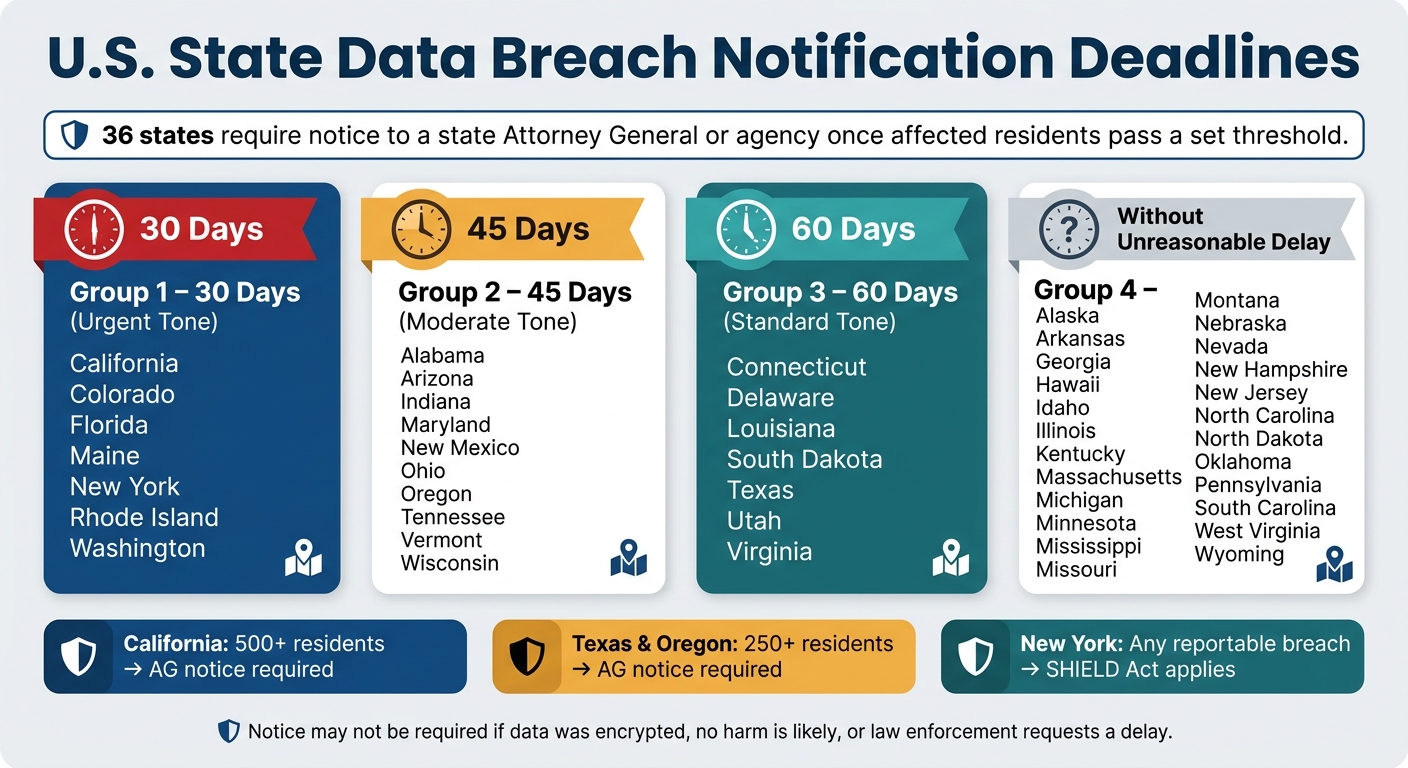
U.S. State Data Breach Notification Deadlines for Actors
Under U.S. law, breach notice turns on two things: where the affected actors live and what data got exposed. That means top casting platforms have to follow the laws of every state where affected users live, not just the state where the company is based.
In most states, notice is triggered when unencrypted PII is accessed or acquired. The big trouble spots are usually Social Security numbers and driver's license numbers. Some states also include biometric and health data. For actors, that distinction matters a lot. The main issue isn't whether public profile details were exposed. It's whether the files included identity data or health data.
State notification timelines and regulator reporting
The timeline isn't the same across the country. Some states set firm deadlines like 30, 45, or 60 days. Others use the looser standard of notice without unreasonable delay.
| Deadline | Key States |
|---|---|
| 30 days | California, Colorado, Florida, Maine, New York, Rhode Island, Washington |
| 45 days | Alabama, Arizona, Indiana, Maryland, New Mexico, Ohio, Oregon, Tennessee, Vermont, Wisconsin |
| 60 days | Connecticut, Delaware, Louisiana, South Dakota, Texas, Utah, Virginia |
| Without unreasonable delay | Alaska, Arkansas, Georgia, Hawaii, Idaho, Illinois, Kentucky, Massachusetts, Michigan, Minnesota, Mississippi, Missouri, Montana, Nebraska, Nevada, New Hampshire, New Jersey, North Carolina, North Dakota, Oklahoma, Pennsylvania, South Carolina, West Virginia, Wyoming |
There is another layer here: regulator reporting. Thirty-six states require notice to the Attorney General or another agency once the number of affected residents passes a set threshold.
A few examples show how uneven this can get:
- California requires Attorney General notice when more than 500 residents are affected.
- Texas and Oregon set that threshold at 250 residents.
- New York requires notice for any reportable breach under the SHIELD Act.
Why some incidents trigger notices and others do not
Not every security incident leads to a legal duty to notify. In many states, notice is not required if the exposed data was encrypted and the key was not compromised. A lot of states also skip notice when investigators find no reasonable likelihood of harm. And if law enforcement says notice would interfere with an investigation, that notice can be delayed.
If notice is required, the next issue is practical: how the platform sends it, and what the notice has to say.
How actors are notified and what the notice includes
Email, mail, in-app alerts, and public notices
Once notice is required, the platform needs to do one thing fast: tell affected actors in a clear way.
When a casting platform has to notify users after a breach, the usual channels are:
- Postal mail
- In-app alerts or banners
If direct notice isn't practical, the platform may use substitute notice. That usually means a website posting plus statewide media notice.
Key details to look for in a breach notice
A breach notice should explain what happened, what data was exposed, what the platform did, what you should do next, and how to get help.
| Notice Element | What to Look For |
|---|---|
| Incident summary | Plain-language description of the breach and date range |
| Data categories | Specific information exposed, such as emails, passwords, phone numbers, addresses, or Social Security numbers |
| Platform response | Containment steps such as system isolation, security audits, or credential rotation |
| Your next steps | Password resets, 2FA or MFA, fraud alerts, or credit freezes |
| Support contact | Toll-free number, dedicated support email, or mailing address |
| Monitoring offer | Activation code for free credit monitoring or identity protection services |
Some notices also include free credit monitoring or identity-protection enrollment.
One more thing: don't enter your password or Social Security number through a link in the notice. Go straight to the platform's official site or app instead.
What actors should do next and how Castmenow (Cast Me Now) fits into safer account management
Steps to take right after a breach notice
Once you receive the notice, move FAST.
Change your password right away. Then turn on MFA for both your casting account and your email. After that, check your recent submission history and profile settings for any changes you didn’t make.
If payment data was exposed, look through your bank and card statements for charges you don’t recognize. If sensitive identity data, such as Social Security numbers or ID documents, was exposed, place a fraud alert or credit freeze with Equifax, Experian, and TransUnion. You can also review your credit report for free at annualcreditreport.com.
Treat follow-up emails and texts with caution. Use only the platform’s official site or app when you sign in. If you think fraud may be involved, report it to the FTC at reportfraud.ftc.gov.
Using Castmenow (Cast Me Now) to keep casting workflows organized
After you lock down your account, the next job is staying organized so current work doesn’t slip through the cracks.
Castmenow helps you keep submissions and active opportunities organized on top of existing casting platforms.
Final takeaway
Use the notice as your action list. Secure your accounts, then watch for signs of fraud right away.
FAQs
How do I know if my account was affected?
Watch for official notices from the platform. If your data was exposed, they have to tell you.
You can also check trusted cybersecurity sources, news reports, or tools like Have I Been Pwned to see if your email shows up in known breach databases. Then read the breach notice closely to confirm what data was exposed and how much risk you may face.
What should I do first if my ID data was exposed?
First, read the breach notice closely so you know exactly what was exposed. You can also check trusted tools like Have I Been Pwned to confirm whether your data showed up.
That matters more than people think. If the breach only exposed your email address, your next move may be changing passwords and watching for phishing. If it included contact details or sensitive identifiers, you may need to freeze your credit or keep a close eye on bank and card activity for unauthorized charges.
Why might breach notices arrive at different times?
Breach notices don't all show up on the same timeline because the U.S. doesn't use one federal rule for this. Instead, state laws set the pace.
Some states require companies to send notice within 30 to 60 days. Others use broader language, like without unreasonable delay.
The clock can shift for a few other reasons too. It may depend on when the breach is discovered, how long it takes the company to figure out who was affected, and whether law enforcement asks for a delay during an active investigation.