How Actors Join Niche Film Groups Online

Small film groups often post acting work before big casting sites do. If I want more leads, better local fit, and more referrals, I need to join the right groups, check them fast, set up a role-specific acting portfolio, and act like a helpful member instead of treating every group like a job board.
Here’s the full idea in plain English:
- I search by niche + casting/auditions + city or region
- I focus on 6 group types: indie film, student film, commercial, voiceover, theater, and regional
- I check each group for rules, admin quality, pay details, dates, location, and contact info
- I never pay any upfront fee to audition or book a role
- I make my profile easy to scan with name, city/state, union status, headshot, reel/demo, and recent credits
- I write a short intro that says who I am, why I joined, and what work fits me
- I build trust by replying on time, joining group activity, and keeping self-promo light
- I track replies, auditions, and referrals each month so I know which groups are worth my time
- I keep networking, submissions, and follow-up as separate weekly tasks
A few facts stand out. The article points to a common target of 10–15 submissions per week for actors who submit often, and it stresses that many voiceover jobs are remote, so VO groups may not need a city-based search. It also makes clear that local details matter in many film and theater groups, down to things like a 50-mile travel radius or local hire only notes.
Quick comparison
| Group type | What I look for first | What matters most in my profile | Main risk to avoid |
|---|---|---|---|
| Indie film | Dates, pay, director, project status | Reel, indie credits, schedule flexibility | Vague posts with no track record |
| Student film | School name, course, professor, timeline | Reliability, openness, local access | No written terms on pay or footage |
| Commercial | Usage, fitting dates, session fee | Look, union status, on-camera work | Ignoring usage terms |
| Voiceover | Demo fit, gear talk, remote workflow | Demos, vocal range, home studio | Weak demo or poor audio setup |
| Theater | Rehearsal schedule, training focus | Stage résumé, local availability | Underestimating time commitment |
| Regional | City, pay, shoot dates, travel radius | Local status, driving range, mixed credits | Wasting time on work outside my area |
Bottom line: if I keep my profile clear, follow the rules, and show up each week with useful comments and clean replies, these smaller groups can turn into a steady source of auditions, contacts, and referrals.
sbb-itb-daa9c42
How to Find and Vet the Right Groups by Niche and Location
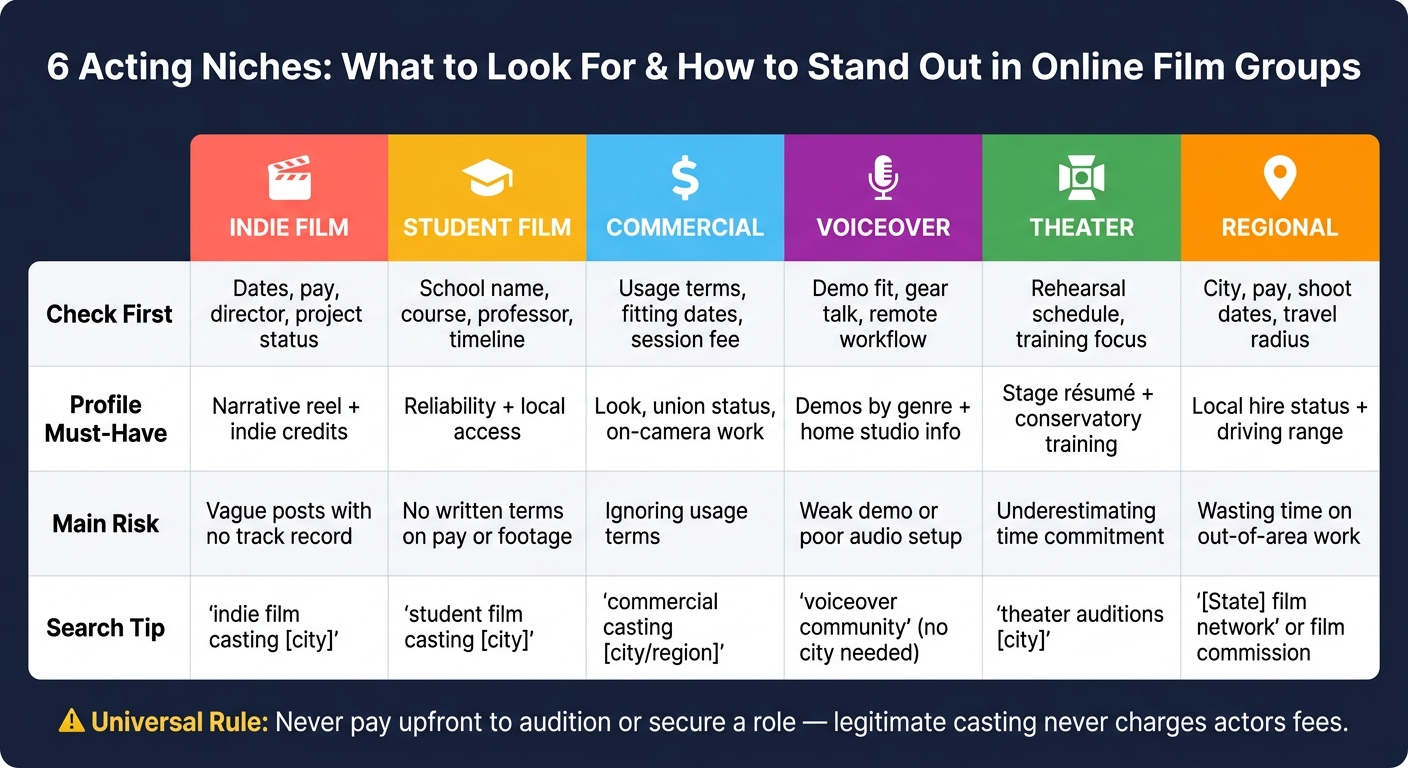
6 Acting Niches: What to Look For & How to Stand Out in Online Film Groups
Search Terms That Match Each Type of Acting Work
The aim isn't to find every group. It's to find the small number that fit your niche, your location, and where you are in your career.
Start with niche-specific keywords. Then add location. If needed, add platform terms like "Facebook group", "Discord," or "Reddit" to pull up organized communities.
A simple formula works well: niche + "casting" or "auditions" + city, state, or region.
| Niche | Example Search Terms |
|---|---|
| Indie film | "indie film casting Los Angeles", "microbudget film casting Austin", "indie film crew and casting Brooklyn" |
| Student film | "student film casting Chicago", "film school casting Dallas", "NYU student film actors" |
| Commercial | "commercial acting auditions Atlanta", "commercial casting San Francisco Bay Area", "brand campaign casting Dallas" |
| Voiceover | "voiceover community", "VO actors group", "voiceover Discord server", "voiceover meetup Los Angeles" |
| Theater | "theater auditions New York", "community theater casting Denver", "equity theater auditions Chicago" |
| Regional | "Georgia film network", "Texas filmmakers group", "[State] film commission" |
One thing to note: many U.S. voiceover jobs are remote, so VO searches often work fine without a city tag.
What to Check Before Joining or Replying
Once you find a group, streamline your casting search by vetting it fast before you post or reply.
Think of your first look as a quick audit. Check the pinned posts and the About section for rules and regional focus. Read the comments and see how people respond to weak or vague posts. Are experienced members pushing back? Are the admins easy to identify? Groups run by casting directors, producers, film professors, local film commissions, or established theater companies carry more weight than groups run by anonymous or brand-new profiles.
A well-run group usually has clear rules around:
- pay
- harassment
- self-promotion
When you look at a project listing, confirm four things before you respond: a real production company or school program name, clear shoot dates and location, an honest pay statement, and a professional contact method such as a link to one of the top casting platforms or institutional email.
Then do one more pass. Check the group's website, social media, and IMDb for past work. Legit teams can verify their credits directly.
One hard rule applies across every niche: never pay upfront to audition or secure a role. Legitimate casting does not charge actors upfront fees of any kind.
How Each of the 6 Niches Works Once You Are Inside the Group
After you've vetted the group, don't jump in right away. Watch the posting rhythm first. A group can tell you a lot just by how people post, reply, and follow up.
Indie film groups move fast. You'll often see short-notice casting calls, pickup days, and reshoot requests. The stronger posts usually include a logline, the director's name, project status, dates, and pay. Posts tied to teams with IMDb pages or festival laurels tend to be a safer bet than anonymous listings with fuzzy budgets.
Student film groups usually move at a slower pace and feel more team-oriented. Good posts often mention a course name, professor, or film department. Before you commit, get pay, footage delivery for your reel, and the production timeline in writing. It's also smart to ask whether the shoot is registered with the film department. Legit student productions follow school safety and insurance protocols.
Commercial groups are the most business-focused. Posts tend to zero in on look, type, and availability, along with exact shoot and fitting dates. Watch the usage terms closely. Regional versus national use, plus duration, directly affects your rate. Strong listings usually spell out a session fee and usage fee or point to union standards.
Voiceover communities spend as much time talking about craft and gear as they do talking about jobs. Demos, acoustics, equipment, and rates tend to fill the feed. In these spaces, people earn respect by having strong demos and leaving useful comments.
Theater groups put more weight on training and live performance credits. A strong stage résumé, conservatory training, or regional theater credits matter here. The culture also leans hard toward rehearsal commitment, not fast bookings.
Regional groups are a mixed bag in the best and worst sense. You might see indie films, streaming series, commercials, and stage auditions all in the same week. Start with metro-area terms like "DFW", "Twin Cities," and "DMV," then branch out to state-level groups. Focus on posts that list a city, shoot dates, pay, and driving-radius terms like "within 50 miles of Charlotte" or "New Mexico local hires only." That local filter helps you spend time on groups where your profile and availability actually line up.
How to Set Up Your Profile and Write an Introduction That Feels Professional
Once you’ve checked that a group is worth your time, the next step is making sure your profile fits that niche at a glance. Before you post anything, your profile should do some quiet heavy lifting. Most group members and admins skim fast, and a thin or mixed-up profile can make it seem like you’re not set up for pro-level work.
Profile Details That Make Group Members Take You Seriously
Your core profile should include your full name, city and state such as Austin, TX, union status (SAG-AFTRA, non-union, or Equity Membership Candidate (EMC)), primary acting work, a current headshot, at least one reel or demo link, and 3–5 recent, relevant credits or training items. Your group profile should match your casting profile as closely as possible. When the details line up, people notice.
Keep your media short and labeled in plain English. A link like Film reel (2:15) or Commercial VO demo – 45 sec tells people what they’re about to open before they click. That small detail helps, especially on mobile, where people want something fast and easy to play.
The table below shows what matters most in each niche:
| Profile Element | Indie Film | Student Film | Commercial | Voiceover | Theater | Regional |
|---|---|---|---|---|---|---|
| Full name | Required | Required | Required | Required | Required | Required |
| City & state | Local shoot focus | Campus access | Market casting | In-person sessions | Theater proximity | Central focus |
| Union status | Helpful | Usually optional | Very important | Helpful | Important | Helpful |
| Headshots | Character-ready | Simple, current | Brand-friendly | Secondary | Current, professional | Shows you are local |
| Reel/demo links | Narrative reel | Scenes or class work | Commercial spots | Demos by genre | Performance clips | Mix with local work |
| Credits/training | Indie shorts/features | Student projects | Brand spots, workshops | VO classes, gigs | Plays, conservatory | Regional films, plays |
| Availability/radius | Helpful | Helpful | Helpful | Note turnaround times | Critical for runs | Critical |
If you’re in voiceover groups, shift the focus from visuals to audio. Add your vocal range, note your home studio setup, and sort demos by genre - commercial, narration, character. That way, people can find the right sound fast instead of hunting through one long playlist.
A Simple Intro Post Structure That Does Not Sound Like a Pitch
A good intro post can be just three sentences: who you are, why you joined, and what kind of connection would help.
Here’s how that plays out across niches:
| Niche | Tone | What to Emphasize | Example Call to Action |
|---|---|---|---|
| Indie film | Collaborative, grounded | Character work, micro-budget flexibility | Tag me in casting threads or table reads for shorts and features. |
| Student film | Supportive, learner-friendly | Reliability, openness to process | Loop me into thesis or class project casting posts. |
| Commercial | Crisp, professional | On-camera presence, brand fit | Add me to self-tape calls that match my look types. |
| Voiceover | Technical and creative | Vocal range, home studio setup | Share scripts or VO casting calls where I might fit. |
| Theater | Ensemble-oriented | Stage experience, training | Tag me in auditions, readings, or workshop performances. |
| Regional groups | Community-minded, practical | Local hire status, travel radius | Include me in regional casting lists or local production threads. |
Skip broad lines like versatile performer ready for anything. That kind of wording sounds polished, but it doesn’t say much. A line like non-union actor based in Chicago focused on grounded indie drama gives people something clear to remember, and that tends to build more trust than high-energy wording.
After that, read the group rules before you post or message anyone.
How Castmenow (Cast Me Now) Supports Profile Consistency Across the Casting Workflow
Castmenow (Cast Me Now) helps keep your casting information aligned across platforms, which gives you more time for niche-group networking. That means you can spend less time fixing profile details and more time building trust inside the group.
How to Follow Group Rules and Build Trust Through Useful Participation
Read the Rules Before You Post or Message Anyone
Start with the pinned rules or the About section. In actor groups - whether they're indie, student, commercial, voiceover, theater, or regional - that's where you learn how to step in without seeming careless.
Pay close attention to things like:
- limits on self-promo
- required post format
- union labels
- paid work vs. credit-only work
If you're replying to a casting call or posting one yourself, include the basics up front: city and state, shoot dates, pay, and a direct way to reach you, like an email address or casting profile link. Moderators use those rules to weed out vague or exploitative posts. When you follow them, you show that you understand how the group works and that you respect people's time.
Once your posts line up with the rules, the next part is simpler: show up in ways that help.
Habits That Lead to Better Referrals and Replies
Trust usually comes from steady, useful participation. Comment when you have something worth adding. Answer questions from newer members about audition prep or on-set etiquette. If the group runs virtual table reads or script feedback sessions, join one - and then follow through. That's the kind of thing people remember when a role opens up.
Be plain about your experience and availability. If you can, reply within 24 hours. Prompt replies signal reliability, and reliability is often what leads to referrals.
Keep your outreach focused. Send a DM only if someone asked for one or if you have a clear shared context. That approach feels respectful, not random. It also makes group activity easier to turn into a weekly habit instead of a scattershot push.
What to Avoid If You Want to Be Taken Seriously
Some behaviors hurt an actor's standing fast, especially in small niche groups. Posting your reel or headshot over and over during the same week starts to feel like noise. Public arguments with casting directors or other members can make you seem hard to work with, and word travels fast in tight scenes. Missing casting details wastes time and can set off red flags. Inflated credits have a way of getting found out quickly.
The table below shows how a few common patterns affect trust and access:
| Behavior pattern | Effect on reputation | Effect on opportunities |
|---|---|---|
| Weekly useful participation (comments, Q&A, table reads) | Builds steady credibility; moderators stay supportive | More organic referrals and replies over time |
| Daily promo blasts (reels, headshots, follow requests) | Quickly read as spammy; risks mutes or bans | Short-term visibility, long-term avoidance by serious collaborators |
| Personalized, context-based DMs | Seen as respectful and professional | Higher response rate and stronger one-on-one connections |
| Mass DMs with identical text | Flagged as intrusive; damages trust immediately | Low-quality leads, possible removal from the group |
Keep self-promo in the background. Participation comes first. In most groups, referrals go to actors who contribute before they ask. It also gets much easier to keep those habits going when networking, manual vs automated submissions, and weekly outreach each have their own place.
How to Turn Group Activity Into a Steady Weekly Workflow
Keep Networking, Scouting, and Submitting Separate
Once your profile and etiquette are in place, turn your group activity into a weekly routine.
The big idea is simple: treat niche groups as places to be seen and get to know people, not as your main submission channel. Keep your week split into three lanes: networking, submissions, and follow-up.
That separation helps you stay organized. It also makes it much easier to see what's paying off and what's just eating up time.
Track a few basic numbers by group each month:
- Replies
- Auditions
- Referrals
If a group isn't leading to anything usable, cut it from your routine. No need to keep pouring energy into a dead end.
Use Automation to Free Up Time for Relationship-Building
Once submissions sit in their own lane, automation can take over the repetitive parts.
Actors who submit on a steady basis often aim for about 10–15 submissions per week. Doing that by hand gets old fast, especially if you're also trying to stay active in several niche groups. That's where Castmenow (Cast Me Now) comes in.
Castmenow works on top of casting platforms. It monitors opportunities, checks role fit, and handles submissions. So instead of spending hours on repeat tasks, you can put more time into group participation, follow-up messages, and the relationship work that automation can't do for you.
Cadence shifts by niche, so your tone and pace should match the setting:
| Niche | Group engagement | Submission review | Follow-up cycle |
|---|---|---|---|
| Indie film | Responsive and flexible | Review regularly | Follow up on warm leads |
| Student film | Concise replies | Check frequently | Prompt |
| Commercial | Quick turnaround | Check frequently | Quick and clear |
| Voiceover | Demo-driven | Watch for role fit | After demos or requested materials |
| Theater | Schedule-focused | Regular rhythm | Longer cycle |
| Regional groups | Location-aware | Review regularly | Match local production pace |
Conclusion: Join Smaller Groups With a Clear Profile, a Useful Intro, and Steady Etiquette
Use groups for visibility, platforms for submissions, and automation for repetitive tasks.
FAQs
How many groups should I join at first?
Start with a small, manageable number of niche groups that line up with your goals, like indie film, student projects, or local theater.
Focus on quality over quantity. If you join too many groups at once, it can get overwhelming fast. And when that happens, it’s harder to show up in a meaningful way. As you build a steady presence and form strong connections, you can slowly branch out into more groups.
What should I do if a casting post looks suspicious?
If a casting post seems off, protect yourself first and apply only through platforms you trust. Don’t share private personal or financial details unless the booking has been fully verified.
Report suspicious activity to the platform right away. It also helps to keep a firm line between your work materials and your private contact details, so you can limit your risk while looking into new opportunities.
How often should I post or comment in these groups?
Consistency matters more than posting all the time. Stay active in a way that fits your brand, and treat engagement like a regular habit instead of a one-off task.
A weekly review of your activity is a good rhythm. It helps you spot trends, fine-tune how you interact, and stay visible without looking spammy.