Top 5 Profile Features Casting Directors Notice

Your casting profile is your digital audition. Before you even meet a casting director, they evaluate your headshot, credits, skills, and reel in seconds. A polished, updated profile increases your chances of being noticed and called back.
Key Takeaways:
- Headshot: Professional, current, and aligned with your casting type.
- Credits: Relevant, well-organized experience that matches your target roles.
- Skills: Focused, verifiable abilities tailored to specific roles.
- Demo Reels: Short, targeted clips showcasing your strengths.
- Profile Data: Accurate, searchable, and consistently updated.
Profiles with complete and relevant details get 53% more submissions. Ensuring clarity, consistency, and alignment with industry expectations can make all the difference.
Ep. 258: How to Improve Your Acting Profile to Book More Auditions Fast
1. A Professional Headshot That Matches Your Casting Type
Your headshot is the first thing a casting director sees, and they form an opinion in mere seconds. In fact, casting directors typically decide in under three seconds whether to move forward or pass. There's no time for them to check your credits or watch your reel at this stage.
"Your headshot has one job. Prevent the immediate 'no' and earn the click to your reel." - Takunda Muzondiwa, Writer at AKTA Photography
Relevance to Target Roles
Your headshot should clearly reflect your casting type. Whether you're aiming for roles as a comedic lead or a dramatic supporting character, everything about your photo - your expression, wardrobe, and overall vibe - should align with that goal. A generic headshot that doesn't convey your unique type won't stand out in a sea of submissions.
Clarity and Professionalism
Technical quality is critical. Casting directors often browse 60–120 thumbnails per page, each only about 100–150 pixels wide. If your photo is dark, blurry, or visually cluttered, it won't grab attention. A February 2026 study by Allcasting confirmed that poorly lit or unclear images are frequently overlooked. To stand out, use a clean, neutral background, proper lighting, and simple wardrobe choices that keep the focus on your face.
Beyond being technically clear, your headshot should also meet the stylistic expectations of the industry.
Alignment With Casting Director Expectations
In the U.S. casting world, the standard is clear: natural trumps overly polished. Excessive retouching, once considered helpful, now raises red flags for casting directors.
"Heavy retouching is the second-fastest casting director pass after dead eyes." - Chris McCarthy, professional photographer
A professional headshot session, which typically costs between $395 and $695, should deliver images that are honest, clear, and aligned with industry norms.
Consistency With the Actor's Current Look
An outdated headshot can damage trust. If your photo doesn't accurately represent your current appearance, casting directors may lose confidence in your submission. Central Casting highlighted in April 2026 that outdated or heavily edited photos often create confusion during the casting process. The general rule is to update your headshot every 12–24 months, or sooner if your appearance changes significantly, such as with a new hairstyle or weight change.
"Your headshot should represent what you actually look like today." - Sovane Photography
This first impression is crucial and sets the tone for the rest of your profile, which will be explored further in the next sections.
2. Role-Specific Credits and Clear, Relevant Experience
Once your headshot grabs attention, casting directors will only spend a few minutes reviewing your profile. At this stage, your credits need to do the heavy lifting - showcasing your casting type and proving you're the right fit for the roles you're targeting.
Relevance to Target Roles
One common mistake actors make is listing every single credit they’ve ever earned. Instead, focus on the roles that best align with the type of work you're pursuing. If dramatic television is your goal, lead with your strongest TV drama credits. Looking for theater gigs? Put your stage work front and center. The idea is to make it crystal clear that you’re the right person for the job.
"A short quality list is better than a long quantity list." - Charles Jones, Author at allcasting
Clarity and Professionalism
How you present your credits is just as important as the credits themselves. Organize them under clear categories like Film, Television, and Theatre to make them easy to scan. Each entry should include the production name, your role, and either the production company or director. Clean, professional formatting not only makes your profile easier to read but also leaves a strong first impression.
Alignment With Casting Director Expectations
Casting directors often look beyond the surface of your credits - they’re assessing how well your experience aligns with their needs. A well-curated list reflects your understanding of the industry and your casting type. On the flip side, a disorganized or overly broad list can work against you.
"Your credits detail your experience, while your showreel demonstrates your ability." - Lauren Harvey, Author at StageMilk
Additionally, regularly updating your profile with fresh and relevant credits can help your visibility on casting platforms. These platforms tend to prioritize profiles that stay current and relevant over those that simply list a high volume of work. Keep your credits up to date to ensure you’re not just seen but also noticed.
3. Targeted Skills, Training, and Certifications
Your credits showcase your past work, but your skills and training reveal what you can deliver right now. This section can either position you as a top contender or quietly remove you from the running.
Relevance to Target Roles
Focus on the skills and certifications that match your target roles. If you're aiming for action-packed roles, highlight combat training or stunt certifications. Hoping to land a part in a bilingual production? Put your language fluency front and center. Skills like accents, dance styles, sports expertise, and dialect training often catch a casting director’s eye.
"Only list skills you can confidently perform on camera - bilingualism, accents, sports, dance, or combat training." - allcasting
Steer clear of irrelevant skills that might distract from your strengths or confuse casting directors about your suitability.
Clarity and Professionalism
How you organize this section matters. Arrange your skills into clear categories like Languages, Physical Skills, Dialects & Accents, and Training Programs to make it easy for casting directors to scan. For training, include specifics such as the institution, program or coach, and the year you completed it. Avoid vague descriptions - be precise (e.g., "Meisner Technique, William Esper Studio, 2024").
"Regular updates are a necessity. Keeping information up to date will improve the actor profile's visibility on the respective platform." - Charles Jones, Blog Author, allcasting
Alignment With Casting Director Expectations
By 2026, casting platforms are using algorithms that heavily weigh skills and training when matching profiles to roles - often more than overall experience. A newer actor with a sharp, focused profile can outrank a seasoned actor with a cluttered, unfocused one.
"Actors should try to list not only their direct acting performance experiences but also other relevant facts and specific skills about themselves, which could give them the upper hand when competing for acting gigs." - Charles Jones, Author at allcasting
Think of this section as a precision tool. Every skill or certification you list should make casting directors say, "This is exactly who we’re looking for." A focused, well-organized profile keeps you competitive and ensures you stand out in the search for the perfect fit.
sbb-itb-daa9c42
4. Current, Focused Demo Reels and Clips
After your headshot and credits, your demo reel is the next big opportunity to showcase your casting potential. While a striking headshot might grab attention, it's your reel that convinces casting directors to stay - or move on.
Relevance to Target Roles
A scattershot reel leaves casting directors guessing where you fit, and they simply don’t have the time for that. Think of your reel as a tool to position yourself, not a collection of random highlights. It should clearly convey your "Casting DNA" - the unique energy and emotional essence you bring to a role - instead of serving as an exhaustive catalog of past work.
"Your reel isn't a scrapbook. It's a positioning tool." - Adria Tennor, Actor/Coach
Every clip should reinforce your suitability for specific roles. Specialist reels can be especially effective here. For instance, labeling a clip as "Stage Combat – Unarmed" or "French Accent" allows casting directors to immediately verify a skill without sifting through unrelated footage. Beyond content, the reel’s technical quality and presentation are just as critical.
Clarity and Professionalism
Keep your reel short and impactful - industry standards suggest 60–90 seconds. First impressions are formed quickly, so lead with your strongest material. Casting directors often make decisions within the first 30 seconds, leaving no room for a slow buildup. On platforms like Spotlight, only the first six video clips are visible without clicking "Show More", making the order of your clips a strategic choice.
Technical quality also plays a big role. Ensure clean audio, neutral backgrounds, and simple lighting to keep the focus on your performance. Overly elaborate setups can feel distracting or even less authentic.
Alignment With Casting Director Expectations
In addition to technical clarity, your reel needs to align with the expectations of casting directors.
"If you can't show us in 30 seconds that you are the character, we are going to tune out. Casting decisions begin forming within the first viewing pass, so clarity and immediacy are essential." - Susan Goforth, Casting Director
A reel filled with wildly varying tones and styles can feel disjointed. Instead of showcasing versatility, it may come across as unfocused. A concise, 60–90 second reel that highlights your core type will resonate far more than a longer, scattered montage.
Keeping Media Up to Date
Outdated footage can hurt your chances. If your reel no longer reflects your current look or skill level, it wastes both your time and that of casting directors. Keeping your reel accurate builds trust, which is crucial for getting callbacks. In today’s digital-first industry, where casting decisions are often made without in-person auditions, your reel might be the only impression you leave. Regularly review and update your reel to ensure it aligns with your current goals and appearance.
5. Accurate, Searchable Profile Data and Consistent Branding
Once you've captured attention with stunning visuals and engaging reels, it's crucial to ensure your profile is easy to find and fully updated. Casting platforms rely heavily on database filters to narrow down talent, so missing or incomplete information can mean your profile won't even show up in search results. Profiles with gaps are often automatically filtered out, leaving you invisible to casting directors.
Relevance to Target Roles
The more complete your profile, the better your chances of being seen. Casting directors use highly specific criteria - like playing age, ethnicity, native accents, union affiliations, and whether you're a local hire. If any of these fields are left blank or contain errors, you’re unlikely to appear in their searches. For example, location is a key factor that many actors overlook. Productions often prefer local hires to save on travel and lodging costs, so an inaccurate or missing location could disqualify you before anyone even considers your talent.
"Just to be submitted (for a role) is a win, because already your agent thinks you're right for it. If I click on you, I think you might be right for it. If I audition you, two people really think you're right for it." - Virginia Anello, Casting Director, O'Connor Casting Company
Clarity and Professionalism
Every detail you add to your profile plays a role in searchability. Information like phonetic name pronunciation, pronouns, and owned props can trigger specific bookings for background or stand-in roles. To stay competitive, industry experts suggest updating your profile every 4–6 months. This isn't just about keeping your information current - platform algorithms often prioritize active accounts, so regular updates can boost your visibility. On the flip side, profiles left untouched for over a year may be flagged as inactive, reducing their chances of appearing in searches.
"It's your job as an actor, and your agent's job as an agent, to make the casting director's job as easy as possible. You don't want to send them links that they have to click on that take them outside of the system that they're using." - Jason Teresi, Client Success Manager, Casting Networks
Taking the time to ensure accurate and complete data not only improves search results but also reinforces a polished and professional image.
Consistency With the Actor's Current Look and Brand
Your headshot, bio, credits, and reel should all tell the same story about who you are as an actor. Casting directors often make decisions in seconds. If your headshot suggests a "girl next door" vibe but your reel leans toward intense drama, it creates confusion and undermines your credibility.
"The main job of the actor's casting profile is to give the viewer, whoever they may be, an aligned vision of who you are as an actor. You want to make sure that all of your materials are telling the same story." - StageMilk
Start your bio with your casting type - like "comedic performer" or "dramatic actor" - to instantly communicate your niche and boost your profile's keyword relevance. A cohesive profile ensures that even if you're not a fit for a current role, casting directors can easily remember and shortlist you for future projects. Tools like CastMeNow can help automate submissions on platforms like Casting Networks and Actors Access, ensuring your polished profile works for you 24/7.
Effective vs. Ineffective Profile Practices: A Quick Comparison
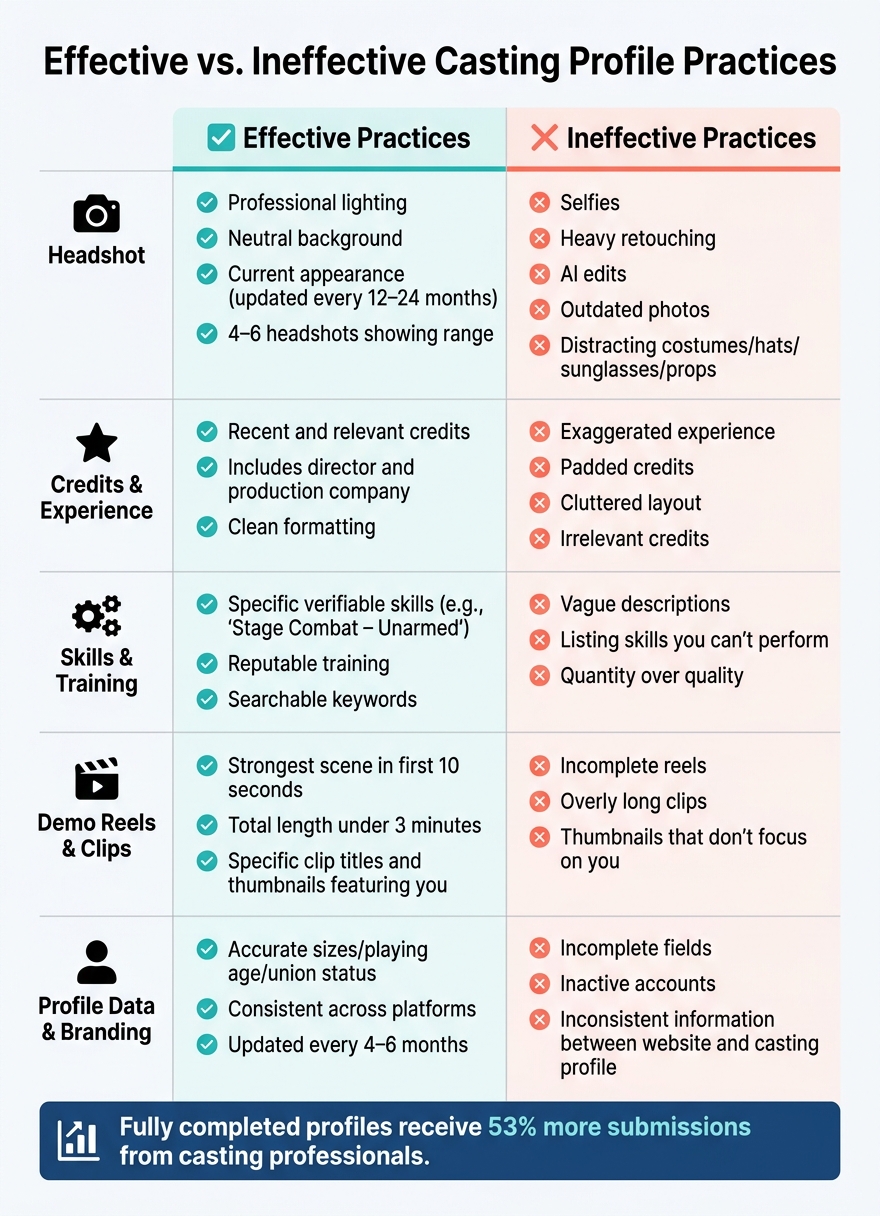
Effective vs. Ineffective Casting Profile Practices
Here’s a straightforward guide to help you navigate the do's and don'ts for key profile elements:
| Profile Feature | Effective Practice | Ineffective Practice |
|---|---|---|
| Headshot | Use proper lighting, a neutral background, and ensure your appearance is current (within the last 12–24 months). Include 4–6 headshots that showcase your range. | Avoid selfies, heavy retouching, or AI edits. Outdated photos and images with distracting costumes, hats, sunglasses, or props are unprofessional. |
| Credits & Experience | Highlight recent and relevant credits, including the director and production company, with clean and clear formatting. | Don’t exaggerate your experience, pad your credits, or clutter your layout. Irrelevant credits can dilute your professional image. |
| Skills & Training | List specific, verifiable skills (e.g., Stage Combat – Unarmed) and reputable training. Include searchable keywords to make your profile stand out. | Steer clear of vague descriptions or listing skills you can’t confidently perform. Prioritize quality over quantity. |
| Demo Reels & Clips | Start with your strongest scene in the first 10 seconds. Keep the total length under 3 minutes. Use specific clip titles and thumbnails that clearly feature you. | Avoid incomplete reels, overly long clips, or thumbnails that don’t focus on you. These can confuse or lose interest quickly. |
| Profile Data & Branding | Ensure all details - like sizes, playing age, and union status - are accurate and consistent across platforms. Update your profile every 4–6 months. | Incomplete fields, inactive accounts, or inconsistent information between your website and casting profile can hurt your credibility. |
By sticking to these simple yet effective benchmarks, you’ll align your profile with what casting directors are looking for.
"Ensure your headshot and reels immediately focus on you, as casting directors decide in seconds."
The key to a successful profile is clarity, accuracy, and consistency. A profile that’s honest, complete, and regularly updated will always stand out over one that’s flashy but falls apart under scrutiny. Keep refining to stay ahead in the game.
Conclusion
Your casting profile is more than just a resume - it's your ongoing audition. Every detail, from your headshot to the accuracy of your profile data, plays a role in showing casting directors who you are and what roles suit you best. Together, these elements create a complete picture that can leave a lasting impression.
Did you know fully completed profiles get 53% more submissions from casting professionals compared to incomplete ones? That extra effort could be the key to standing out and landing more opportunities. A well-crafted, focused profile not only grabs attention but also increases your chances of callbacks.
Once your profile is in top shape, keeping it visible is crucial. That’s where CastMeNow steps in. By syncing with platforms like Casting Networks and Actors Access, it keeps your optimized profile in front of the right people by submitting it to relevant roles automatically - day and night. No more endless manual searches; your profile works tirelessly on your behalf.
With a polished profile and consistent updates, you can turn possibilities into real opportunities.
FAQs
How many headshots should I upload?
Casting directors suggest uploading 4–6 headshots to your profile. This number strikes a balance between showing off your range and keeping things manageable. Aim to highlight a variety of styles - such as commercial and theatrical looks. Make sure your photos are high-quality and accurately represent how you look right now.
Using tools like CastmeNow can make the process easier. It helps you organize and label your headshots, automatically pairing the right photo with the right role to improve your chances of landing auditions.
What credits should I leave off my profile?
When updating your resume, remove credits that are outdated or no longer relevant to your current goals. For instance, childhood roles may not accurately represent your current skills or age. Instead, highlight your most recent and noteworthy credits that align with the work you're targeting. A clean, focused resume makes it easier for casting directors to spot your most applicable experience, encouraging them to explore your qualifications further.
How often should I update my profile and reel?
To stay ahead in the game, make it a habit to update your profile and resume regularly - ideally every month or at least every 3–6 months. Add any new skills, credits, or experience as soon as they happen. Use headshots that are no older than six months to ensure casting directors can easily recognize you. Keep your demo reel fresh by showcasing your most recent work and abilities. Tools like CastmeNow can simplify the process by automating submissions, freeing up more of your time for networking and personal growth while keeping your profile up-to-date.